





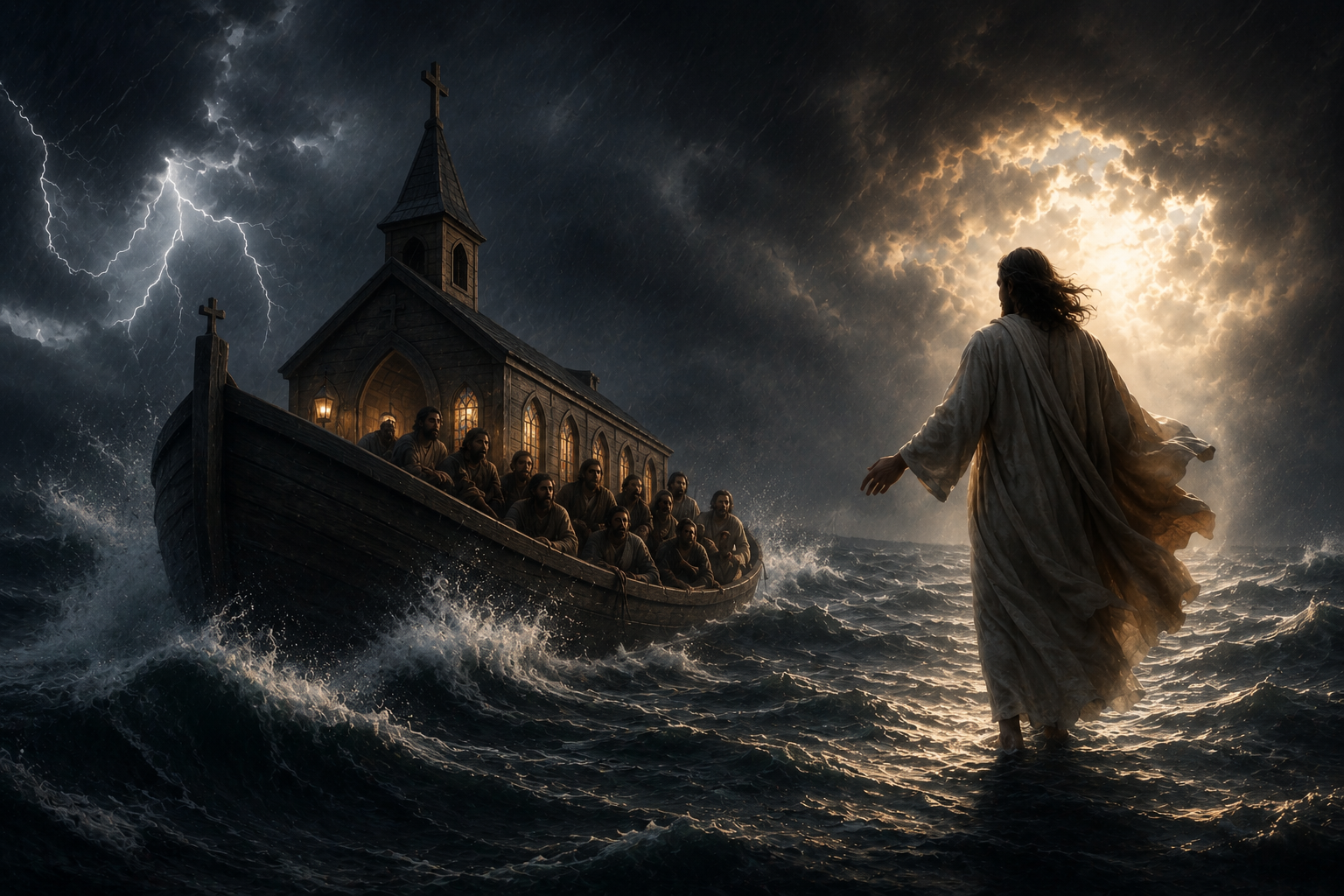
There are moments when the Gospel seems less like a distant story and more like a mirror held before the Church. Matthew’s account of Jesus walking upon the waters is one of them. Jesus sends the disciples ahead in the boat while He withdraws to the mountain to pray. Night falls, the boat is far from land, and the waves batter it because the wind is against it. The disciples are struggling against forces they neither understand nor control.
St Thomas Aquinas likens the boat as an image of the Church journeying through the trials of history. The sea evokes the unstable conditions through which she travels, while the storm represents all that assails her from without and within: persecution, hostility, scandal, disbelief, financial and moral corruption and the temptation to think that Christ has abandoned His people. Yet the greater danger is not simply that the storm exists, but that those within the boat may lose sight of the One for whom the journey exists.
When Jesus approaches, walking upon the sea, the disciples do not recognise Him. Their fear is so great that they mistake their Saviour for a ghost. We can become so absorbed in the darkness that we no longer recognise Christ when He comes towards us through it. His first words are therefore not an explanation of the storm, but a revelation of His presence: “Take heart, it is I; do not be afraid.”
This has particular significance for those entrusted with the pastoral care of the Church. The existence of a storm does not excuse poor leadership. There is a form of ecclesial cowardice that disguises itself as prudence. We may speak boldly when speaking costs us nothing, yet become silent when fidelity to Christ requires courage. We may become highly competent in managing institutions, committees, finances and ceremonies while becoming strangely incapable of defending the faith when doing so becomes inconvenient.
The temptation is especially serious for shepherds. Pride can replace humility, ambition can replace service, political calculation can replace pastoral charity, and self-preservation can quietly replace fidelity to God and the Gospel. The desire to be admired can become stronger than the desire to manoeuvre the boat and lead souls to Christ. When those who ought to strengthen the Church’s confidence become absorbed in their own position or security, the faithful inevitably begin to despair.
The failures of shepherds must therefore be named truthfully, especially when the weak have been wounded and the truth obscured. Yet Christian truth does not end in denunciation. Christ does not abandon wounded shepherds or wounded sheep. He calls both to healing and repentance; He restores responsibility and sends them again in grace and service. The Gospel is not merely a summons to expose failure but an invitation to conversion. Just as a battered boat can be repaired, similarly, the wounded Church is not beyond redemption because Christ has not ceased to be her Lord.
The enemy does not always need to destroy the boat from outside. It is enough, at times, to make those within it so absorbed in their fears, positions and interests that God gradually ceases to be the centre of their vision. We may remain busy and outwardly impressive while becoming inwardly disoriented, merely speaking about mission while forgetting renewal and neglecting conversion.
Peter’s actions reveal the same danger on a personal level. His request is bold: “Lord, if it is you, command me to come to you on the water.” For a moment, his desire for Christ is stronger than his fear. Yet when he notices the strong wind, he becomes frightened and begins to sink.
The wind was already there. What changed was the direction of Peter’s attention. When his gaze was fixed on Christ, the storm did not have the final word. However, when the storm became the centre of his awareness, fear overcame him. Peter does not sink because the storm is stronger than Christ, but because he allows the storm to become greater in his vision than Christ Himself.
Is this not also a diagnosis of much of the Church’s anxiety today? We look at scandals, hostility, declining numbers, political divisions, institutional weakness and the failures of clergy and faithful alike. None of these things should be ignored. But if the storm becomes the principal object of our contemplation, fear will soon become the principal disposition of our hearts.
The answer is not to deny the storm, but to look beyond it towards the One who is coming.
There is a beautiful and almost unsettling observation from St John Chrysostom concerning Christ’s apparent delay in approaching the disciples. He suggests that the Lord allowed them to struggle so that, when He finally came, He might be desired more. The thought echoes the prophet: “My soul yearns for you in the night” (Isaiah 26:9). The darkness need not signify God’s absence. Sometimes God permits the night to deepen so that the soul may discover how profoundly it desires the light.
Perhaps this is one of the questions we face today: Do we still desire Christ Himself?
This is why the Eucharist brings us back to the heart of the mystery. The Church does not endure because her members are always courageous, her clergy always faithful or her institutions always well managed. She endures because Christ remains faithful to her. In the Eucharist, Christ is not merely remembered or admired. He gives Himself to His Church as the living Lord.
Upon the altar, the Church encounters the same Lord whom the disciples struggled to recognise upon the stormy sea. The Eucharist is therefore not an escape from the storm, but the source of the grace by which the Church passes through it without losing her centre. If our gaze remains fixed upon Christ, the storm may wound us, but it cannot define us.
Perhaps, then, the most important question in an age of ecclesial anxiety is not, “How severe is the storm?” but “Where are we looking?”
If we look only at the storm, we shall despair. If we look only at the failures of clergy and laity, we shall become bitter. If we look only at the hostility of the world, we shall become frightened. But if we look towards Christ in the Eucharist, the storm is placed within its proper perspective. It remains real, but it is no longer sovereign.
The Church does not need shepherds who merely know how to manage the boat. She needs shepherds who know why the boat exists and towards whom it is travelling. She does not need Christians who merely complain about the darkness but Christians who know the source of the light.
The boat may be battered, wounded and exhausted; the waves may be violent, and the night may be long. Yet Christ has not abandoned us. The storm is real, and it may wound the Church deeply, but it is not sovereign, for the endurance of the Church rests not upon the courage of her sailors, the perfection of her shepherds or the strength of her institutions, but upon the fidelity of Christ.
Christ still comes through the darkness, still approaches the fearful and still stretches out His hand to those who are sinking. And when the noise of the waves threatens to overwhelm the Church, she must learn again to recognise the voice of the One who has never ceased to be with her: “Take heart, it is I; do not be afraid.”