





There are, one must admit, more immediately inviting ways of beginning a book than with a genealogy.
Matthew opens his Gospel and, before we have travelled very far, we find ourselves walking through a long procession of names: Abraham begot Isaac, Isaac begot Jacob, Jacob begot Judah and his brothers… and so it continues. For the modern reader, accustomed to introductions that promise to seize our attention within the first few seconds, Matthew appears almost heroically unconcerned with marketing.
One can imagine someone beginning the New Testament with great enthusiasm, reaching Matthew 1, encountering the seemingly endless succession of fathers and sons, and quietly wondering whether perhaps Mark might be a more sensible place to begin.
But Matthew knows exactly what he is doing.
The genealogy is not an obstacle before the Gospel begins. It is already Gospel.
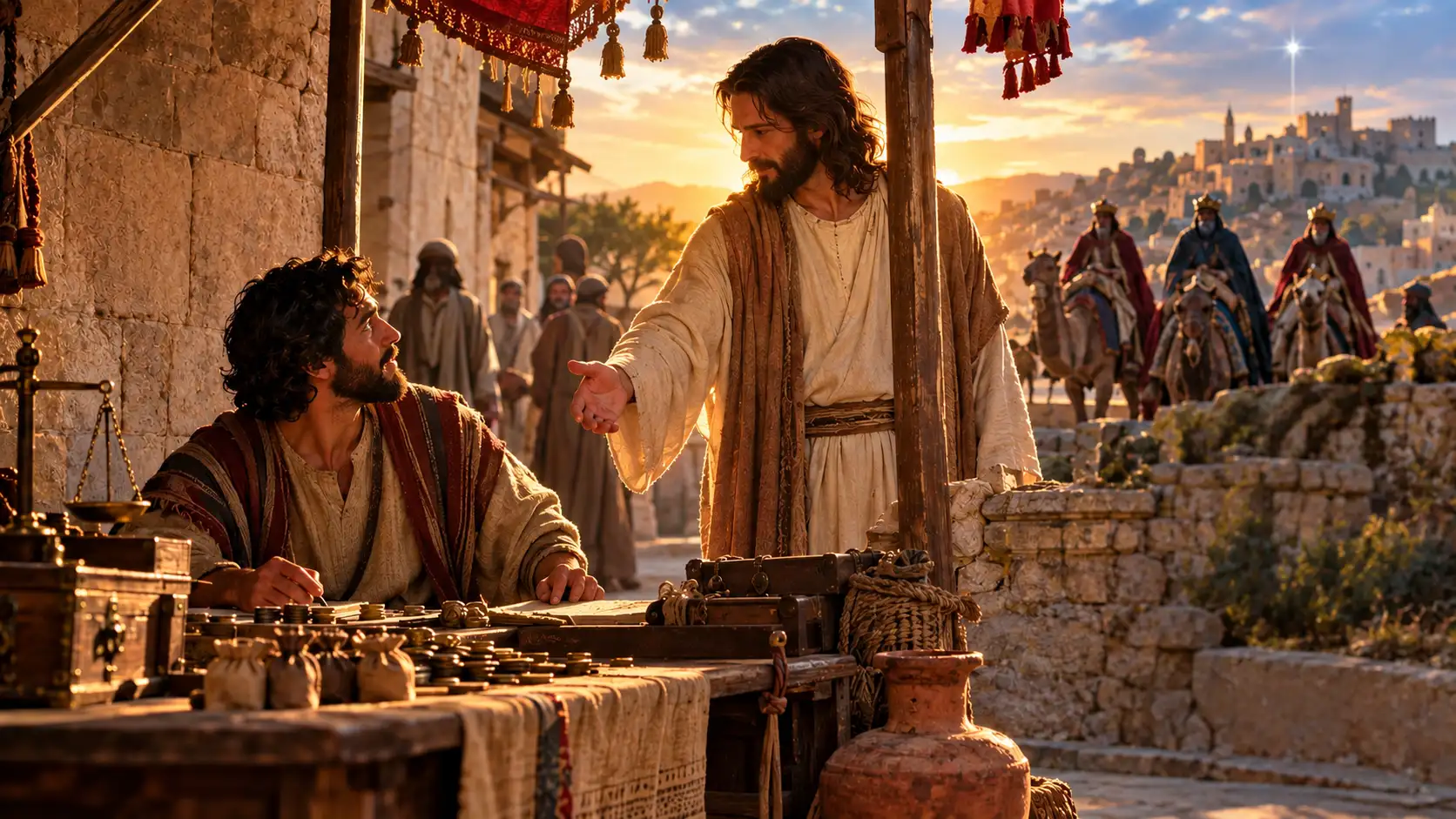
St Thomas Aquinas offers a beautiful key for understanding this. He distinguishes the Synoptic Gospels according to different aspects of the dignity of Christ: Matthew particularly manifests the royal dignity of Jesus. Hence he begins by showing Christ’s descent according to the flesh through the royal line and, shortly afterwards, presents the mysterious visitors from the East coming to adore the Child. The genealogy leads us to David; the star leads the Magi to Bethlehem. Both point towards the same mystery: the Child is the King.
The ancient Christian tradition contemplated the four Gospels in precisely this way. They are not four competing biographies, but four gazes directed towards the one Face of Christ. Matthew begins with His human generation; Mark with the voice crying in the wilderness; Luke with the world of sacrifice and priesthood; John, like the eagle, rises immediately towards the eternal mystery of the Word. Thus arose the familiar symbols of the man, lion, ox and eagle.
Each Evangelist opens a window. Through all four windows enters the same Light.
And Matthew’s window has something particularly human about it.
The man behind the Gospel
Perhaps this is appropriate, because Matthew himself knew something about the complicated material from which human histories are made.
Before he became an Apostle, he was a tax collector.
Now, at the risk of introducing a wholly unauthorised addition to apostolic tradition, one might occasionally wonder whether Matthew had some distant ancestors in Gujarat, India.
I stress immediately, for the sake of biblical scholarship and my Gujarati brethren: this is satire.
There is absolutely no manuscript hidden in the Vatican Archives proving that Levi’s grandfather migrated from Ahmedabad to Capernaum.
Still, the circumstantial evidence is amusing. Matthew understood accounts. He knew taxation. He apparently knew his way around money. And then, almost two thousand years later, when The Chosen needed someone to portray him, the role went to Paras Patel, an American actor of Gujarati heritage.
Providence? Coincidence?
The Congregation for the Causes of Saints is unlikely to open an investigation.
But beneath the joke lies something rather beautiful. The man who had spent his life calculating value was about to encounter Someone whose value could not be calculated.
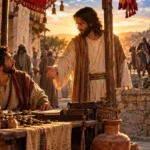
Matthew was sitting at the tax office.
Jesus passed by.
And everything changed.
“Follow me”
There is an extraordinary economy in Matthew’s account of his own calling:
“Follow me.”
And Matthew rose and followed Him.
No lengthy discernment is recorded. No negotiation. No request to reconsider the financial implications. No spreadsheet entitled Projected Consequences of Apostolic Discipleship.
He gets up.
Benedict XVI saw something profound in precisely this brevity. Matthew’s immediate rising reveals the readiness of his response. He leaves behind not merely a desk, but a way of life and, significantly, a reliable source of income. His physical rising becomes almost an outward image of an inward resurrection: detachment from the old life and attachment to a new life in communion with Christ.
Here we touch the heart of Matthew.
Christian conversion is not fundamentally self-improvement. It is not the polishing of one’s religious résumé until one finally becomes presentable to God.
Conversion begins because Christ passes by.
He sees.
He calls.
And a human being discovers that he can rise.
Matthew does not first become respectable and then follow Jesus. Jesus calls him while he is still sitting at the tax booth.
Grace precedes respectability.
Mercy precedes merit.
The gaze of Christ sees in Matthew something that Matthew’s neighbours, and perhaps Matthew himself, could no longer see.
A scandalous choice
We easily domesticate the Apostles because statues make them look so respectable.
Give a man a halo, put a Gospel in his hand and place him on a church pedestal for several centuries, and we forget how scandalous his biography once appeared.
Matthew was a publican.
Tax collectors were associated not merely with money but with collaboration, impurity and exploitation. Benedict XVI pointed out that Matthew belonged to a category of people regarded in Israel as public sinners. Yet Jesus does something astonishing: He does not merely tolerate this man. He makes him one of the Twelve.
This tells us something essential about Christianity.
God does not merely forgive our past. He can transform it.
The hands that counted taxes would one day serve the Gospel.
The memory trained to keep accounts would remember the words of the Master.
The house perhaps once associated with questionable money would become a place of encounter.
And the sinner would become an Apostle.
This is the peculiar arithmetic of grace.
God does not deny the past, but neither does He permit the past to have the final word.
Matthew opens his house
There is another detail that deserves attention.
Matthew does not simply leave something behind. He places what he possesses at the service of encounter.
His house becomes a table.
And his table becomes a bridge.
Soon Jesus is eating there with tax collectors and sinners. The Pharisees appear as well, although apparently less enthusiastic about the guest list. Suddenly Matthew’s home contains an extraordinary cross-section of society: Christ, disciples, public sinners, religious observers, critics and curious onlookers.
The former tax collector has become, almost immediately, a man who brings worlds together.
This may be one of Matthew’s most beautiful lessons for the Church today.
We often imagine evangelisation as bringing people into explicitly religious spaces. Matthew does something simpler. He lets Jesus enter his space and then allows others to encounter Him there.
His house becomes missionary because Christ is present within it.
Matthew does not need to have all the answers. He simply creates the possibility of an encounter.
And perhaps this is what Christian hospitality is ultimately meant to be.
Our homes, friendships, professions, conversations, talents and tables can become bridges upon which another person unexpectedly encounters Christ.
The physician at the table
Naturally, not everyone approves.
“Why does your teacher eat with tax collectors and sinners?”
It is the perennial religious temptation: to imagine holiness principally as distance from the unholy.
Jesus responds with one of those sentences in which the whole Gospel seems suddenly concentrated:
“Those who are well have no need of a physician, but those who are sick.”
Benedict XVI drew from Matthew’s story a wonderfully simple conclusion: Jesus excludes no one from His friendship. The Good News consists precisely in God’s grace being offered to the sinner.
This does not mean that sin is unimportant.
Quite the opposite.
A physician comes because sickness is real.
But the physician does not stand at the door of the hospital shouting accusations at the patients. He enters because he desires their healing.
Christ sits at Matthew’s table because divine holiness is not fragile. Mercy is not afraid of contamination. God can enter the wounded places of human existence precisely because His light is stronger than our darkness.
And Matthew knows this personally.
Before he could preach mercy, he had been looked upon with mercy.
Before he wrote the Gospel, the Gospel had happened to him.
From counting coins to announcing a Kingdom
There is, finally, something wonderfully appropriate about Matthew becoming the Evangelist who speaks so insistently about the Kingdom.
He once worked for an earthly administration.
He collected revenue.
He knew what political authority looked like, what money could command and how earthly kingdoms maintained themselves.
Then Christ walked past his desk and introduced him to another Kingdom.
A Kingdom whose King is found first as a Child.
A King before whom Magi kneel.
A King who calls sinners to His table.
A King who reigns not through domination but through self-giving love.
A King whose throne will finally appear in the paradoxical form of the Cross.
Perhaps this is why Matthew’s long genealogy matters so much after all.
Those names are not merely names.
They are human history: saints and sinners, fidelity and failure, nobility and disgrace, kings and exiles, promise and disappointment. And through that very history, with all its fractures, God quietly prepares the coming of Christ.
The genealogy therefore tells us something Matthew himself came to know.
God is not embarrassed by human history.
He enters it.
He enters complicated families.
He enters compromised lives.
He enters morally ambiguous professions.
He enters houses filled with questionable guests.
He even enters tax offices.
And when He enters, He calls.
“Follow me.”
Matthew rises.
Perhaps the deepest question raised by his feast is therefore not whether we admire him. Saints were never given to the Church merely to be admired from a safe distance.
The question is whether somewhere within us there remains a tax booth at which we are still sitting.
Something secure.
Something profitable.
Something familiar.
Perhaps even something sinful.
We may have become so accustomed to sitting there that we can no longer imagine ourselves anywhere else.
And then Christ passes by.
He does not begin with an accusation.
He begins with an invitation.
Follow me.
The Gospel does not tell us that Matthew carefully closed his accounts before leaving.
Perhaps for once, the accountant left the books unfinished.
Because he had discovered that there are moments when life cannot be calculated.
There are moments when grace must simply be answered.
Matthew rose and followed Him.
And perhaps holiness begins, again and again, in precisely that movement:
to hear the voice of Christ,
to discover that mercy has already found us,
and then, at last,
to rise.