






There is something almost surprising about the Gospel chosen by the Church for the feast of the Nativity of the Blessed Virgin Mary. We celebrate the birth of Mary, yet the Gospel says nothing about her birth. Indeed, the Scriptures themselves preserve no account of that moment. There is no description of the child Mary, no scene surrounding her cradle, no announcement of her arrival into the world.
Instead, St Matthew turns our gaze immediately elsewhere:
“This is how the birth of Jesus Christ came about.”
At first sight, this may appear a curious choice for Mary’s birthday. Yet perhaps the Church, in placing this Gospel before us, is already teaching us something essential about Mary herself. Mary cannot finally be understood by looking at Mary alone. Her mystery becomes intelligible only in relation to Christ.
Even on the day on which the Church celebrates her birth, Mary quietly directs our eyes towards the birth of Another.
This is, in fact, the deepest character of Marian devotion. Mary does not obscure Christ; she makes him visible. She does not retain our gaze for herself, but leads it towards the One for whom her entire existence was prepared. The significance of her birth lies therefore not simply in the appearance of another human life within history, but in the hidden preparation of that human dwelling in which God himself would choose to make his home among us.
In Mary, the humanity of God begins, in a wholly singular way.
She is the unblemished vessel of a divine purpose that infinitely exceeds her. Yet she is not a passive instrument. God does not violate human freedom in order to accomplish salvation. He waits for the response of a human heart. Mary’s greatness lies precisely here: she allows herself to become completely available to God. Her fiat opens human existence to the divine initiative.
And beside her stands Joseph.
Matthew permits us to see something of Joseph’s bewilderment. He encounters a mystery that he cannot understand and initially resolves to withdraw quietly. Yet into his uncertainty comes the word of God:
“Joseph, son of David, do not be afraid to take Mary your wife into your home.”
Those words, “do not be afraid”, reveal something fundamental about the manner in which God enters human history. God does not always remove uncertainty before asking for faith. Mary and Joseph are not given a map of everything that lies ahead. They are asked instead to entrust themselves to a promise.
And the promise is given a name:
Emmanuel.
God with us.
Here we arrive at the centre of the mystery.
The God of Israel had never abandoned his people. He had accompanied Abraham, spoken to Moses, guided Israel through the wilderness, dwelt mysteriously among his people and spoken through the prophets. Again and again, Israel had experienced both human infidelity and divine faithfulness. Man forgets; God remembers. Man breaks his promises; God remains faithful to his.
Now, however, the ancient promise assumes a form that no human expectation could have fully imagined.
God will not simply be for us.
He will be with us.
And even this does not adequately express the radical newness of what is taking place. In Jesus Christ, God does not merely draw near to humanity from the outside. He enters human existence from within. He assumes flesh. He accepts a human face, a human voice, human hands and a human heart. He enters time, vulnerability and mortality.
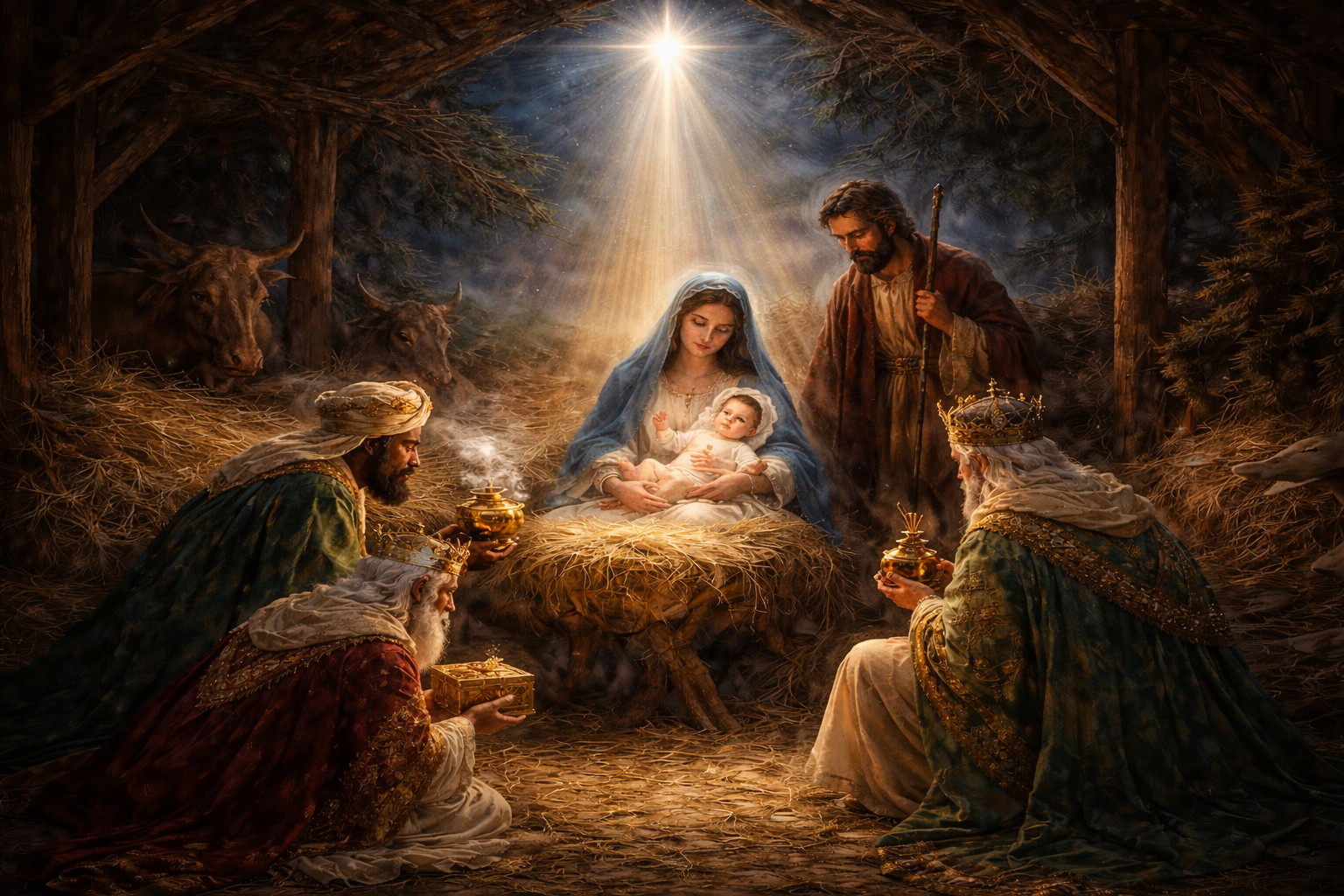
The child carried in Mary’s womb is Emmanuel.
Thus Mary stands at that extraordinary threshold where promise becomes presence.
Through her, the God whom no human eye could contain becomes visible. The eternal Word receives flesh from her flesh. The Creator enters his creation not with the violence of overwhelming power, but with the vulnerability of a child.
Perhaps this is why Mary’s birthday matters so deeply. Her birth is the quiet dawn preceding the sunrise. Nothing spectacular appears to happen. A child is born. Yet within that apparently ordinary event, Providence is already preparing the place from which the Light will enter the world.
God keeps his promises, but often he begins fulfilling them in silence.
And the mystery does not end at Bethlehem.
The name Emmanuel is not merely a description of what happened two thousand years ago. It expresses something of the permanent desire of God for humanity. The God who chose to be with us in the flesh does not subsequently retreat into distance.
This is why the mystery of Emmanuel leads us inevitably towards the Eucharist.
At the altar, the promise “God with us” acquires an intimacy that is almost overwhelming. Christ does not remain merely before us as someone to be admired, nor simply above us as someone to be worshipped, nor only beside us as someone who accompanies us.
He gives himself to us as food.
Christianity therefore dares to speak of an intimacy with God that is not merely intellectual or emotional, nor even simply “spiritual” in the vague sense in which that word is sometimes used. The Eucharistic encounter possesses a profound physical and sacramental concreteness.
“This is my body.”
The Word who received flesh in the womb of Mary continues to give himself through his Body.
In Holy Communion, Emmanuel becomes astonishingly personal: God with me, God entering me, God giving his very self to become the nourishment of my life.
There is perhaps no deeper physical intimacy possible between God and the human person this side of eternity. We do not merely think about Christ. We receive him. The hands that once rested upon the sick, the Body born of Mary, offered upon the Cross and raised from the dead, is given sacramentally to us.
The promise of Emmanuel therefore reaches into the very depths of human existence.
God has kept his promise.
He is with us.
He was with us in the womb of Mary. He was with us in the manger of Bethlehem. He was with us upon the roads of Galilee. He was with us upon the Cross. He is with us in the risen Christ.
And he remains with us in the breaking of the bread.
There is consequently a beautiful movement hidden within today’s feast: from Mary to Christ, from Christ to Emmanuel, and from Emmanuel to the Eucharist.
Mary’s entire existence participates in this movement of divine self-giving. She receives Christ in order that Christ may be given. She carries him so that the world may encounter him. Her motherhood is therefore never possession; it is gift.
Perhaps this is also the deepest lesson of her birthday.
The holiness of Mary consists not in drawing attention towards herself, but in becoming transparent to God. She allows her life to become the place where God’s promise can take flesh.
And this remains the vocation of the Church and, in some measure, of every Christian.
We receive Christ so that Christ may become visible through us.
We receive Emmanuel so that a world haunted by loneliness, abandonment and fear may discover that God has not withdrawn.
And each time we approach the Eucharist, the ancient prophecy quietly becomes present once more:
“They shall name him Emmanuel.”
God with us.
Not as an idea.
Not merely as a memory.
Not only as a spiritual consolation.
But the God who took flesh from Mary, the God who entered human history, the God who promised never to abandon his people, now places himself into our hands and gives himself to us as food.
On Mary’s birthday, therefore, the Church directs our attention towards Christ because Mary herself always does so.
And perhaps, among all the things that might be said in praise of her, there is none more beautiful than this:
Mary makes room for Emmanuel.
And through her, God keeps his promise to dwell among us.