








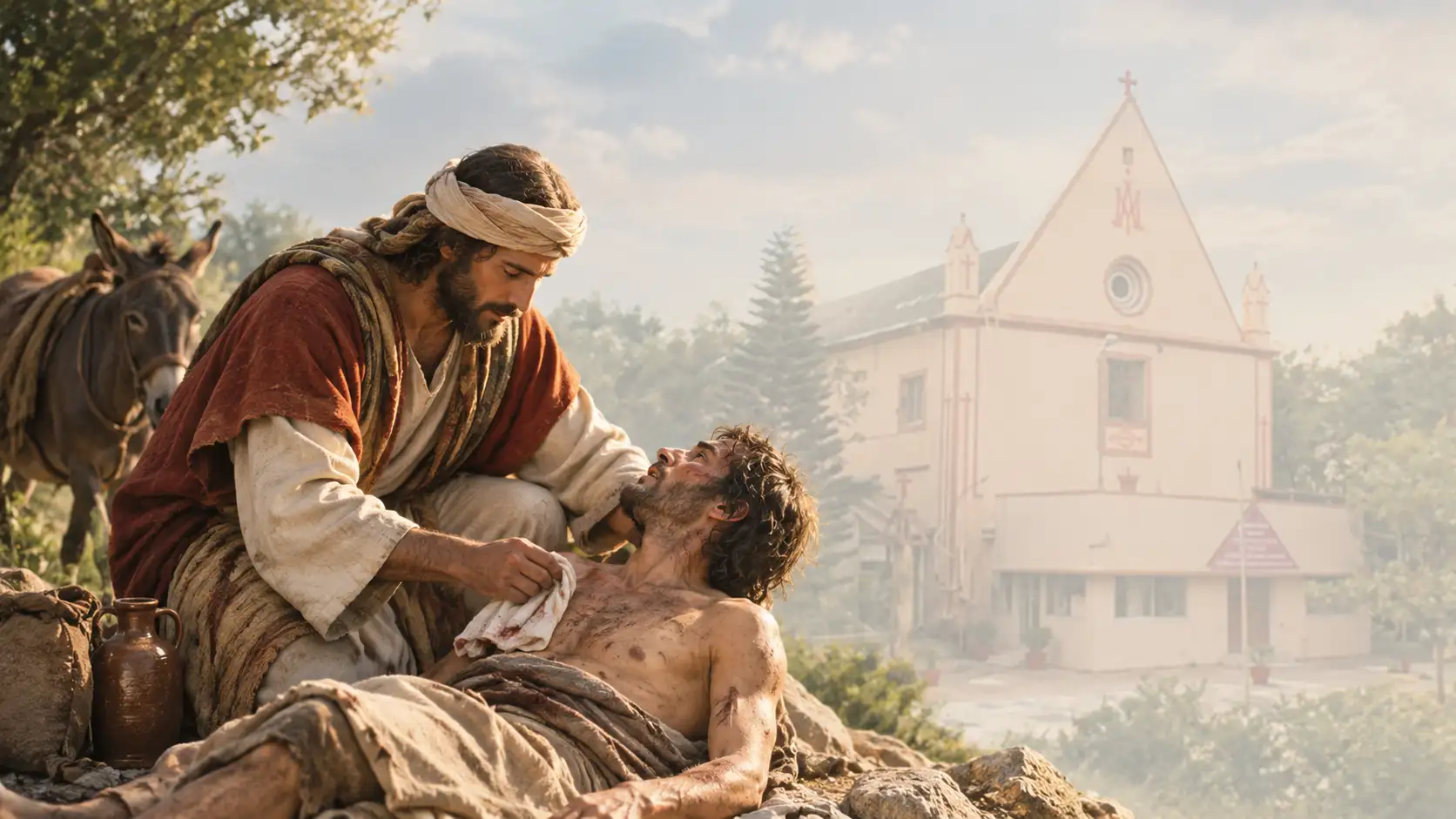
Today’s Gospel [the Good Samaritan] places before us one of those passages of Scripture which has become so familiar that its very familiarity can conceal its depth. We know the story of the man who went down from Jerusalem to Jericho, was attacked by robbers, stripped and left half dead by the roadside. We know, too, that a priest and a Levite passed him by, while a Samaritan stopped, tended his wounds and carried him to an inn.
We have rightly learned to hear in this parable a summons to compassion, a reminder that the neighbour is not simply the person who belongs to our circle, shares our convictions or happens to be convenient to love. Yet the tradition of the Church has always recognised that the parable contains something more profound than an ethical instruction. It reveals something about who Christ is and, at the same time, something about who we are.
Saint Augustine reads the parable on these two levels. The wounded traveller is Adam, and in Adam he sees the whole human race. Jerusalem evokes the city of peace, while the descent towards Jericho becomes an image of humanity’s fall into the condition of sin. The man is stripped, beaten and left unable to save himself. The robbers signify the powers of evil which seek to deprive humanity of the dignity bestowed upon it by God. The priest and the Levite, representing the Law and the Prophets, pass by. They can reveal the wound, expose sin and point towards the truth, but they cannot themselves bring about the healing which wounded humanity requires.
Then the Samaritan appears.
There is already something striking about this figure. The Samaritan is the outsider, the one whom the religious imagination of the time might have regarded with suspicion or even hostility. Yet it is precisely he who allows himself to be interrupted by another person’s suffering. He sees the wounded man, draws near to him and is moved with compassion.
In Augustine’s spiritual reading, the Samaritan is Christ himself, the one who comes to wounded humanity when humanity has no strength to restore itself. The Lord does not remain at a distance from our misery. He enters into it. He approaches the wound, takes responsibility for the wounded person and carries him towards a place where healing can continue.
There is a profound Christian truth here which is easily overlooked. The Gospel does not begin by telling the wounded man what he must do to recover himself. It begins with another coming towards him. The initiative belongs to mercy. Before we are capable of walking towards God, God has already come towards us. Before we can speak of our love for Christ, we encounter the fact that Christ has loved us in our helplessness. The Christian life is therefore not first a story of human achievement but of divine mercy received.
Prefiguration of the Sacraments
The details of the Samaritan’s care make this even more beautiful. He pours oil and wine upon the wounds of the injured man and binds them. The Fathers of the Church have long seen in these elements a sacramental resonance. Oil naturally recalls the healing anointing of the Sacrament of the Sick, in which Christ continues to approach the human person in weakness, illness and suffering.
Wine, meanwhile, points us towards the Eucharistic mystery, where Christ gives not merely something of himself but himself for the life of the world. The Samaritan’s actions therefore allow us to glimpse, even within the imagery of the parable, the healing ministry which Christ would entrust to his Church: wounded humanity is not merely consoled with words but touched, anointed, nourished and restored by grace.
The connection with the Eucharist is especially profound. The same Christ who bends over the wounded person is the Christ whom the Church encounters at the altar. The Eucharist is not an escape from human woundedness into some purely spiritual world. It is the sacramental presence of the One who has entered into our wounded condition and overcome death from within it. The Samaritan does not simply tell the wounded man that everything will be well. He gives of himself for his healing. The Eucharistic Christ continues this self-giving love, drawing us into communion with himself so that the life we receive from him may become a life of charity towards others.
Prefiguration of the Church
The Samaritan then carries the wounded man to an inn and entrusts his continued care to the innkeeper. Augustine sees in the inn an image of the Church. This too gives the parable a depth which is worth recovering. The Church is not a community gathered because its members have no wounds. She is the place to which wounded humanity is brought so that the healing begun by Christ may continue. The Church receives those who are broken, accompanies those who cannot yet walk, binds wounds and makes room for grace to work over time. Christian healing is often not instantaneous. There are wounds which require patience, accompaniment, prayer, sacramental grace and the faithful presence of others. The inn therefore becomes an image of the Church as a place of mercy, where Christ’s work of healing continues through the life of his people.
The Samaritan gives the innkeeper two coins and asks him to care for the wounded man. Augustine connects these two coins with the twofold commandment of love: love of God and love of neighbour. The two commandments belong together because genuine love of God necessarily changes the way we see the person before us. If we claim to love God while remaining indifferent to the wounded person at our side, something fundamental in our understanding of the Gospel has been lost. Conversely, Christian love of neighbour is not simply humanitarian sentiment. It flows from the recognition that every human being possesses a dignity received from God and is therefore worthy of love.
This takes us back to the question with which the parable begins: “And who is my neighbour?” It is a question which seeks a definition, perhaps even a limit. How far does my responsibility extend? Who belongs within the circle of those whom I am obliged to love? Jesus quietly overturns the question. The neighbour is not simply someone whom I discover within a predetermined circle. I become a neighbour when I allow myself to be moved by the person who stands before me in need.
This is why the Samaritan is so challenging. He does not ask whether the wounded man deserves his attention. He does not enquire whether the man belongs to his community, whether he shares his beliefs, whether he will repay the kindness, or whether helping him will make his own journey more difficult. He sees a human being in need, and that is enough. Compassion becomes action. The Samaritan allows another person’s suffering to interrupt his own plans.
There is perhaps no more difficult aspect of Christian discipleship than this. We are often willing to love humanity in the abstract, but the Gospel places a particular person before us. The wounded person has a face. He may be inconvenient. He may be difficult. His wounds may be the consequence of his own mistakes. He may not resemble us in culture, temperament, politics or faith. Yet the command of Christ remains. The question is not whether this person fits my definition of neighbour. The question is whether I will become his neighbour.
And Augustine’s reading brings this moral demand back to its proper foundation. We are not asked to become merciful people simply through an act of willpower. We are asked to become merciful because we ourselves have first been shown mercy. We are the wounded traveller. We too have known the roadside. We too have experienced the consequences of our own weakness and the wounds which we could not heal by ourselves. The Christian cannot look upon another wounded person from a position of superiority, because he knows that he too has been carried.
This changes the meaning of Christian charity. We do not stoop down to another person as though we were untouched by the need for grace. We bend down because Christ first bent down to us. We tend another’s wound because we have ourselves been entrusted to the healing mercy of the Lord. We carry another because Christ has carried us.
The Church therefore has a particular vocation in a wounded world. She must never become merely a place where the healthy congratulate themselves on being healthy. She must remain an inn on the road, a place where the broken can enter, where wounds can be brought into the light, where the sacraments communicate the healing of Christ, and where no one is made to believe that he must first become whole before he is worthy of belonging.
The oil and wine of the Samaritan’s care speak powerfully here. The Church does not possess a medicine of her own invention. She carries the healing of Christ. In the Sacrament of the Sick, the Lord comes close to those who are physically or spiritually burdened by illness. In the Eucharist, the wounded receive the One who gives himself as food for the journey. At the altar and in the life of charity which flows from it, the Church continually receives and gives the mercy of Christ.
Perhaps this is why the Good Samaritan remains such a demanding Gospel. It does not allow us to separate our love of God from our treatment of those whom God places on our road. The person who comes to Mass and receives the Eucharist is being drawn into the very self-giving love which the Samaritan embodies. We cannot receive the mercy of Christ and remain completely indifferent to the wounds of those around us. The Eucharist sends us back into the world with eyes capable of seeing what we might previously have passed by.
The final words of Jesus are therefore not simply an instruction to be nicer people. They are an invitation to participate in the very mercy of God: “Go and do likewise.” Having encountered the Samaritan, we are sent to become instruments of his compassion. Having been carried to the inn, we are asked to help carry others. Having received the oil and wine of healing, we are entrusted with the care of wounds which we encounter along the road.
The road from Jerusalem to Jericho has not disappeared. Humanity remains wounded upon it. There are people who are stripped of dignity by poverty, loneliness, illness, violence, abandonment and sin. There are wounds which are visible and others which are carefully concealed. There are people who have become so accustomed to being passed by that they no longer expect anyone to stop.
Today’s Gospel asks us whether we will.
But before it asks us to become the Samaritan, it asks us to recognise the Samaritan who has already come for us. Christ is the one who sees humanity lying wounded by the roadside and refuses to pass by. He comes near, binds our wounds, pours upon them the healing grace of God, carries us when we cannot walk and brings us into the Church, where his healing continues.
Only when we understand ourselves as recipients of this mercy can we begin to understand what it means to become neighbours.
The Good Samaritan is therefore not simply a story about what good people ought to do. It is first a revelation of what God has done for us in Christ. The command to “go and do likewise” becomes possible because mercy has already found us. We become capable of stopping beside another person’s suffering because Christ has first stopped beside ours.
And perhaps this is the deepest movement of today’s Gospel: from being wounded, to being found; from being found, to being healed; from being healed, to becoming instruments of healing.
The Samaritan comes to us first.
And having received his mercy, we are sent along the road to become neighbours to those whom he places in our path.