




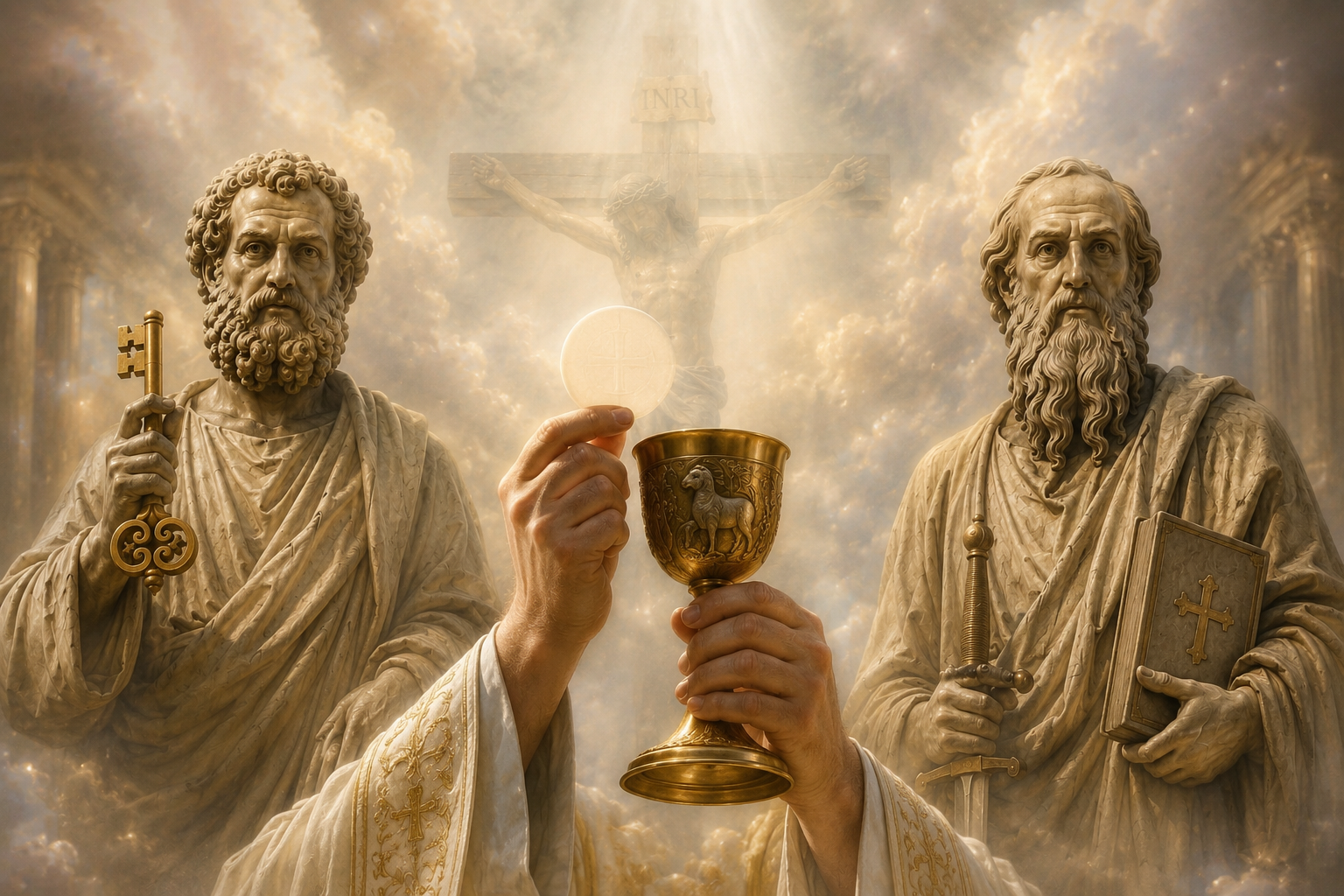
Every year on 29 June the Church celebrates the Solemnity of Saints Peter and Paul together. Have you ever wondered why?
Permit me a little theological imagination.
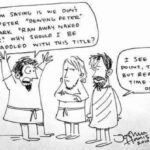
Perhaps after years of watching Peter and Paul engage in spirited debates, the Lord simply decided, “Enough! If I give them separate feast days, Peter will insist his comes first because he received the keys, while Paul will argue that he travelled farther, wrote more letters, and preached to half the known world. Better to give them one solemnity and settle the matter once and for all.”
One can almost picture Peter saying, “The Lord entrusted me with the keys of the Kingdom.”
To which Paul promptly replies, “Quite true, Simon. But I wrote Romans.”
Peter responds, “Yes, but I walked on water.”
Paul smiles. “Briefly.”
Peter clears his throat. “I preached at Pentecost.”
Paul folds his arms. “I evangelised the Gentile world.”
At this point one imagines the heavenly choir quietly beginning another hymn while the angels discreetly change the subject.
Of course, none of this ever happened. Yet there is something delightfully human about these two giants of the apostolic age. Peter was impulsive, direct and passionate. Paul was brilliant, relentless and intellectually formidable. Their personalities could hardly have been more different. Their disagreement at Antioch, recorded in Galatians, reminds us that saints are not plaster statues. They are redeemed sinners who loved Christ so completely that even their disagreements ultimately served the truth of the Gospel.
Far from diminishing the Church, their differences reveal one of her deepest mysteries. Unity does not require uniformity. The same Holy Spirit who called Peter to shepherd the flock also sent Paul to carry the Gospel to the nations.
Peter himself exhorts the faithful, “Like living stones, let yourselves be built into a spiritual house” (1 Peter 2:5). The image is striking. Stones differ in size and shape, yet together they become one dwelling place for God.
Paul expresses the same mystery in different language. “There is one body and one Spirit… one Lord, one faith, one baptism, one God and Father of all” (Ephesians 4:4-6). Diversity of gifts never compromises the unity of Christ’s Body. Rather, it reveals the richness of divine grace.
Indeed, Paul’s Letter to the Romans reaches its magnificent climax in the assurance that nothing “will be able to separate us from the love of God in Christ Jesus our Lord” (Romans 8:39). Peter and Paul discovered this truth not merely through study but through suffering. One would be crucified upside down. The other would bow his head beneath the executioner’s sword. Both sealed their preaching with martyrdom.
Yet beneath their different temperaments, ministries and writings stood one unshakable confession.
Both knew that Jesus Christ was not merely a teacher to be admired, but the living Lord to be encountered.
Nowhere is this more beautifully revealed than in their witness to the Eucharist.
When many disciples abandoned Christ after the Bread of Life discourse, Peter did not claim to understand everything Jesus had said. Instead, he confessed with breathtaking simplicity: “Lord, to whom shall we go? You have the words of eternal life” (John 6:68). Peter remained because he trusted the One who had declared, “My flesh is true food and my blood is true drink.”
Paul would later hand on what he himself had received. “The cup of blessing that we bless, is it not a participation in the blood of Christ? The bread that we break, is it not a participation in the body of Christ?” (1 Corinthians 10:16). Even more solemnly, he warns that anyone who eats and drinks without discerning the body eats and drinks judgement upon himself (1 Corinthians 11:29). Such language makes sense only if the Eucharist is truly the Body and Blood of the risen Lord.
Peter remained because he believed.
Paul preached because he believed.
Peter shepherded the Church because he believed.
Paul crossed seas, endured imprisonments, beatings and shipwrecks because he believed.
Both apostles ultimately directed every soul not towards themselves but towards Christ, truly present in His Church and supremely present in the most Holy Eucharist.
Perhaps, then, the Church celebrates Peter and Paul on the same day for a reason far greater than our playful imagination suggests.
The Rock and the Apostle to the Nations stand side by side because the Church herself stands upon both apostolic authority and apostolic mission. Peter safeguards unity. Paul extends the Gospel to the ends of the earth. Together they remind us that truth must always be accompanied by charity, and doctrine by evangelisation.
And if, in heaven, Peter occasionally reminds Paul that he still has the keys, one suspects Paul simply smiles, points towards the Lamb upon the heavenly altar, and says, “Yes, Simon. But look whom they unlock.”
For in the end, neither Peter nor Paul sought to make disciples for themselves.
They spent their lives leading the world to Jesus Christ, truly present, truly alive, and still feeding His people with the Bread that came down from heaven.