






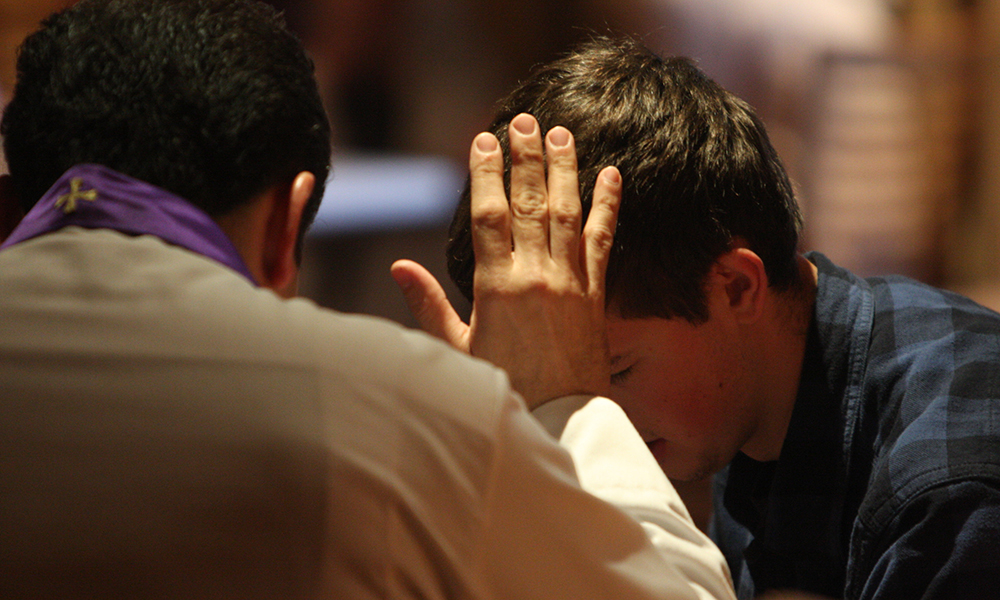
I am sure we all have heard this prayer by the priest prayed at the end of our confession: “God the Father of mercies, through the death and resurrection of his Son has reconciled the world to himself and sent the Holy Spirit among us for the forgiveness of sins; through the ministry of the Church may God give you pardon and peace, and I absolve you from your sins in the name of the Father, and of the Son and of the Holy Spirit. Amen.”
Indeed, this is one of the most beautiful prayers entrusted to the Church: the formula of sacramental absolution. At first hearing, it appears simply as the prayer through which the priest forgives sins. Yet a more attentive reading reveals something far greater. Within a few carefully chosen words, the Church proclaims the entire economy of salvation. The prayer leads us from eternity to time, from creation to redemption, from Pentecost to the life of the Church, before arriving at the personal encounter between Christ and the repentant sinner.
The prayer begins by directing our gaze to the Father: “God, the Father of mercies.” Before there was creation, before humanity, before history itself unfolded, there was God. The Father exists eternally in the communion of the Blessed Trinity, begetting the Son and, with the Son, breathing forth the Holy Spirit. Divine mercy is therefore not an afterthought provoked by human sin. Mercy belongs to the very being of God. It is the eternal love by which the Father delights in the Son and pours Himself out in the Holy Spirit. Salvation begins not with humanity’s search for God, but with God’s eternal love for humanity.
The prayer then turns to the centre of history: “Through the death and resurrection of his Son has reconciled the world to himself.” Here stands the Paschal Mystery, the decisive event upon which the destiny of the world rests. Sin had ruptured the communion between God and man, a wound no human effort could heal. Yet the eternal Son entered our history, took upon Himself our mortality, and upon the Cross bore the weight of humanity’s alienation. His Resurrection is not merely the reversal of death but the inauguration of the new creation. In Christ crucified and risen, reconciliation has become a reality. The Father embraces once more the world that had wandered from Him.
Yet redemption accomplished must also be redemption communicated. Therefore the prayer continues: “And sent the Holy Spirit for the forgiveness of sins.” At Pentecost, the risen Lord fulfilled His promise. The Holy Spirit descended upon the Apostles, not simply to inspire them, but to make present throughout history the saving work of Christ. The Spirit is the living bond between the sacrifice of Calvary and every generation of believers. What Christ achieved once for all is continually applied to souls through the power of the Holy Spirit.
The coming of the Spirit gives birth to the Church. Consequently, the prayer declares: “Through the ministry of the Church may God give you pardon and peace.” The Church is not an institution existing alongside Christ, nor merely a community preserving His memory. She is His Body, animated by His Spirit and entrusted with His authority. The forgiveness offered in the sacrament is therefore not a human declaration of comfort but the living action of the risen Christ through His Church. The Apostles received from the Lord the authority to forgive sins, and this ministry continues through the bishops and priests who act in the person of Christ.
Only after traversing this magnificent panorama of salvation history does the prayer arrive at the individual soul. The priest speaks directly: “I absolve you from your sins in the name of the Father, and of the Son, and of the Holy Spirit.” Eternity enters time. The history of salvation becomes the history of one person. The mercy that existed before the foundation of the world, revealed in the Cross, poured out at Pentecost, and entrusted to the Church, now reaches the penitent standing before God in humility and faith.
This is the extraordinary beauty of the Church’s liturgy. It never isolates the individual from the mystery of Christ. Every sacrament immerses the believer into the great drama of divine love. In the sacrament of Reconciliation, one discovers that confession is not merely an acknowledgement of personal faults. It is an encounter with the entire mystery of salvation. The Father who eternally loves, the Son who redeems through His Passover, the Holy Spirit who sanctifies, and the Church who ministers Christ’s forgiveness all converge in a single moment of grace.
Thus the prayer of absolution is far more than a juridical formula. It is a concise profession of faith, a proclamation of the Gospel, and a hymn to the Holy Trinity whose merciful love accompanies humanity from the beginning of creation until the fulfilment of all things in Christ.
The next time you are in confession, pay very close attention to this prayer, prayed by the priest.