






The Gospel according to John opens not with sentiment, but with eternity: “In the beginning was the Word.” There is no Bethlehem scene, no angels, no stable. John leads us instead into the inner life of God, where the Word exists in eternal communion with the Father. Yet this ascent into divine mystery is not an escape from history; it is the necessary prelude to the most astonishing descent imaginable.
“And the Word became flesh and dwelt among us.”
With this single sentence, the Christian faith is irreversibly altered. God does not merely speak to humanity; He enters it. The Word through whom all things were made chooses not to remain distant, but to assume flesh—real, vulnerable, material flesh. John’s prologue is therefore not abstract. It is among the foundation stones of the Church’s Eucharistic faith, and it shows God in action by revealing himself.
From Eternity to the Altar
The verb John uses—“dwelt among us”—is rich with meaning. It evokes the tabernacle of Israel, the tent in which God chose to make His presence known during the wilderness journey. In Christ, God pitches His tent not among a people but within humanity itself. The Incarnation is God’s irrevocable decision to remain close.
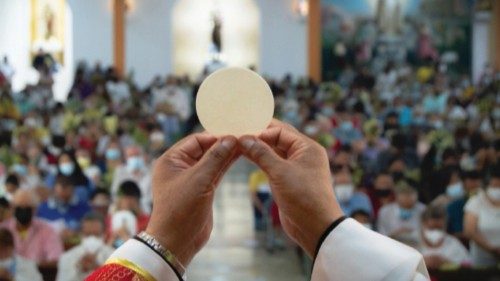
This decision does not end with Jesus’ earthly life. If the Word truly became flesh, then His presence cannot be reduced to memory or symbol. The Eucharist emerges as the inner logic of the Incarnation. What began in the womb of Mary continues on the altar of the Church.
In the Eucharist, the same Word through whom the cosmos was created entrusts Himself to the humility of bread and wine. Eternity consents to be held. Glory chooses concealment. Love becomes consumable—not to be diminished, but to be shared.
Light That Must Be Received
John tells us that “in Him was life, and the life was the light of men.” Yet the Prologue immediately introduces a drama: the Light comes into the world, and the world resists Him. This tension is not resolved once and for all in the past; it is renewed in every generation.
The Eucharist stands at the centre of this drama. Here, Christ does not impose Himself by force. He offers Himself as a gift. The Light of the world comes veiled, vulnerable, dependent upon faith. To approach the altar is, therefore, never a neutral act. It is a response to presence – the Real Presence of God.
Seeing Glory, Receiving Glory
John writes, “We have seen His glory.” Yet the Church dares to claim more. In the Eucharist, believers do not merely see; they receive. The glory glimpsed in the Incarnation is communicated sacramentally. What the disciples touched with their hands, the faithful receive in Communion.
This is why the Prologue is profoundly Eucharistic. The Word becomes flesh so that flesh may receive God. The Son becomes bread so that humanity may share in divine life. The altar is thus the continuation of Christmas—not its symbolic echo, but its living extension.
The Heart as Dwelling Place
The prologue reaches its quiet climax in a statement of grace: “To all who received Him, He gave power to become children of God.” Receiving Christ is not an act of possession, but of transformation. The believer is drawn into the Son’s own relationship with the Father.
Every Eucharist renews this mystery. As Christ once sought shelter in the poverty of a manger, He now seeks a dwelling place in the human heart. Often that heart is unprepared, distracted, or weary. Yet the logic of the Incarnation has never been about worthiness, only about love.
On the feast of St John the Evangelist, the Church listens again to the Prologue—not as distant theology, but as living truth. The Word is still with God. The Word is still God. And the Word still chooses to remain with us. I encourage you to prayerfully read John 1:1-18 and let the Word engulf your soul.
Here, the Prologue does not merely begin.
Here, it continues.
Here, the Word becomes flesh—and waits to be received.