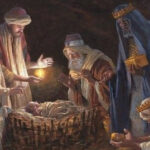







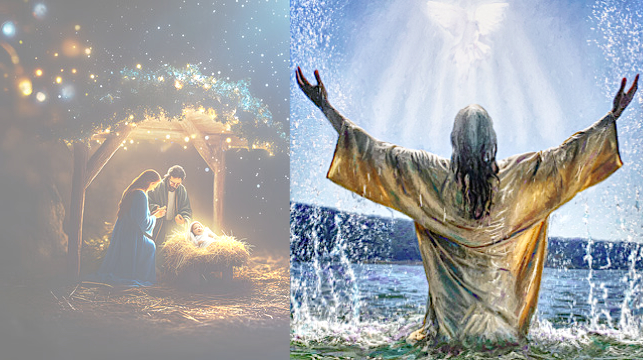
As the gentle radiance of Christmas fades from our liturgical horizon, the Church does not abandon the mystery She has contemplated; She allows it to unfold further. The feast of the Baptism of the Lord stands precisely at this point of transition. The curtains fall on the infancy narratives, yet the drama of salvation intensifies. The baptismal waters begin to flow, carrying with them the promise that what God has begun in the flesh of the Child of Bethlehem will now be revealed for the life of the world.
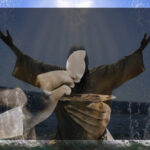
It is at first sight a paradox that arrests us: the Sinless One enters the waters of repentance. John’s baptism was a baptism for sinners, a sign of conversion and expectation. Why, then, does Jesus step into these waters? The answer lies at the heart of the Christian mystery. Our Saviour comes to be baptised not because He needs purification, but because we do. He descends into the Jordan to descend into the depths of the human condition itself, assuming fully the weight of our wounded nature.
Here, in quiet humility, Christ performs a prophetic act. He enters the waters bearing the burden of humanity’s sin, prefiguring that greater descent by which He will enter the darkness of death itself. The Jordan thus becomes a figure of the Cross, and the baptism of Jesus a silent anticipation of Easter. As the Fathers of the Church never tired of proclaiming, it is not Christ who is cleansed by the waters; rather, it is the waters that Christ cleanses.
When Jesus rises from the waters, the heavens are torn open. The Spirit descends like a dove, recalling the first creation, when the Spirit hovered over the primordial waters. A voice is heard: “You are my beloved Son; with you I am well pleased.” This revelation is not reserved for Christ alone. Every baptised person is drawn into this filial relationship with Him. Our baptism is thus not merely a ritual moment in the past but an ontological transformation—a new way of being before God and in the world.
Yet the Gospel does not allow us to linger indefinitely at the Jordan. John the Baptist, whose role is always to point beyond himself, utters words that echo through the centuries: “Behold, the Lamb of God.” With this bold proclamation, the meaning of Christ’s baptism is carried forward toward its fulfilment. The One who descends into the waters is the same One who will offer Himself upon the Cross, and who continues to give Himself to the Church under the humble signs of bread and wine.
Here the Jordan meets the altar. The Lamb revealed at the baptism is the Lamb made present in the Eucharist. At every Mass, the Church takes up John’s words, recognising in faith the same Jesus who once stood in the waters of the Jordan. What was foreshadowed in baptism is consummated in the Eucharist: the self-gift of Christ for the life of the world. The waters that cleanse us lead us inexorably to the table where we are nourished.
Thus, as the Christmas season draws to a close, the Church invites us not into nostalgia but into deeper communion. To remember our baptism is to renew our baptismal promises—to renounce sin, to profess faith, and to live as those who belong to Christ. But it is also to recognise that baptism finds its full expression in Eucharistic life. The Christian is one who has passed through the waters and now lives from the altar.
Standing between font and table, we hear anew John’s cry: “Behold, the Lamb of God.” It is the same cry that resounds in every generation, at every Mass. The Child of Bethlehem, the One baptised in the Jordan, and the Eucharistic Lord are one and the same. And in beholding Him, we are drawn ever more deeply into the mystery of a love that cleanses, heals, and gives itself without reserve.
The mystery of Christmas is unveiled as the Word made flesh, adored in the crib, enters the Jordan to sanctify the waters of our rebirth.