







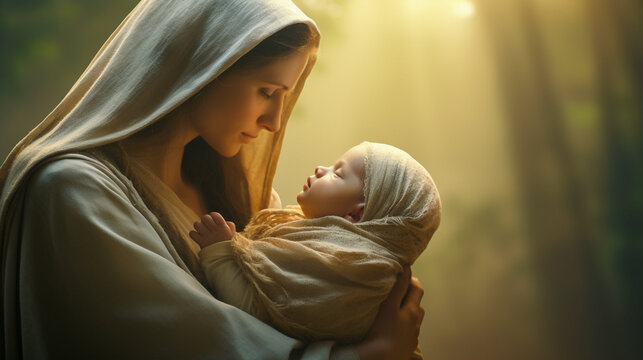
To confess Mary as Theotokos—Mother of God—is not to place a creature above her Creator, but to safeguard the most radical truth of Christianity: that God has truly entered history, not as an idea or a symbol, but as flesh and blood. In this single word, solemnly affirmed by the Council of Ephesus, the Church protects the mystery at the heart of her faith—that Jesus Christ is one divine Person, true God and true man, and that the child borne in Mary’s womb is none other than the eternal Son of the Father.
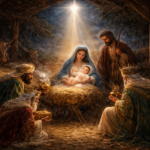
Mary stands at the threshold of this mystery, not as its origin, but as its living space. In her, eternity touched time; in her body, the Word found a dwelling place and became flesh. The title Theotokos, therefore, speaks less about Mary in isolation and more about Christ Himself. To deny her this title would be to fracture Christ, to reduce Him to a moral teacher temporarily clothed in humanity. The Church, in her maternal wisdom, insists otherwise: the one whom Mary conceived by the power of the Holy Spirit is God Himself, made man for our salvation.
Yet Mary’s greatness does not lie in privilege alone, but in faith. Saint Luke describes her as one who “kept all these things, pondering them in her heart.” This interior posture—of listening, receiving, and consenting—reveals the true form of her motherhood. Before she conceived Christ in her womb, she conceived Him in faith. Her fiat was not a momentary gesture but a lifelong surrender, stretching from Nazareth to Bethlehem, from Cana to Calvary. Thus, Mary becomes the icon of the Church: she receives the Word, carries Him within, and offers Him to the world.
To call Mary Mother of God is also to recognise that God chose dependence. The omnipotent One entered history as an infant who needed to be held, fed, and protected. God entrusted Himself to a woman’s care. In this divine humility, we glimpse the logic of love that governs the Incarnation. Mary’s motherhood reveals that God does not save from a distance; He draws near, allowing Himself to be shaped by human tenderness, human vulnerability, and human love.
At the foot of the Cross, Mary’s motherhood is widened. There, as her Son gives His life for the world, she receives a new mission: “Behold your son.” Her motherhood, born in silence at Nazareth, now expands into the mystery of the Church. She becomes the mother not only of Christ the Head, but of His Body, all those who live from His grace. In this sense, Theotokos is not merely a Christological title; it is also deeply ecclesial.
In a world often marked by noise and self-assertion, Mary teaches the primacy of listening. She reminds us that God does not impose Himself; He asks for room. The Word still seeks a dwelling place—not now in a physical womb, but in hearts willing to receive Him. To honour Mary as Mother of God is therefore to learn from her the art of faith: to make space for God, to trust His promises, and to allow His Word to take flesh in our lives.
Here, then, at the threshold of a new year, the Church places before us Mary, Mother of God. Time itself is gathered into her arms, for the one she bears is not only Lord of history but also its meaning and fulfilment. By beginning the year with this solemnity, the Church teaches us how time is to be lived: not as a succession of anxious moments to be mastered, but as a gift to be received in faith. As Mary once received the Eternal Word at the dawn of salvation history, so we are invited, at the dawn of a new year, to receive Christ anew into our lives.
Entrusting our days to the Mother of God, we learn that the future is not an empty space to be feared, but a path already inhabited by Emmanuel, God-with-us, who enters our time through her yes and remains with us in every unfolding moment.