





Following the dramatic resurrection of Jesus, a quiet sorrow settles over the road to Emmaus. Two disciples walk away from Jerusalem, away from the hope they had once dared to taste, away from the promise that now seems to have slipped through their hands. Their conversation grows heavy with grief; their eyes dim with disappointment; their hearts, weighed down, cannot yet recognise the One who draws so close, who walks beside them in such tender silence. And yet, precisely in that movement of retreat, in that fragile turning away, the risen Christ comes nearer still.
This Gospel is not only a story of human consolation. It is a revelation of the liturgical life of the Church, a life in which God does not merely inform the mind, but gently and powerfully draws the heart into communion with Christ.
The journey begins with Christ’s Word
The stranger joins them as they walk, and as they speak, he does not simply correct their disappointment, but he opens a deeper horizon. He interprets Moses and the prophets, unveiling the hidden coherence of salvation history. And something truly happens inside them: their hearts begin to burn, because Christ’s presence is at work through the proclamation of the Word.
In the New Testament, liturgy is not limited to what happens at the altar; it also includes the proclamation of the Gospel and active charity. In a liturgical celebration, the Church shares in Christ’s priestly office, prophetic (proclamation) and kingly (service of charity) and Christ continues the work of redemption in and through his Church. When the Scriptures are proclaimed, Christ’s word is not mere commentary on the past; the Church is a servant in the image of her Lord, and through her, Christ’s action penetrates into the interior life of the faithful.
So the disciples’ burning is not simply emotion. It is the awakening of grace, faith stirring under the authority of the Word, until the heart begins to perceive what the eyes still cannot see.
Yet the story does not end on the road.
The decisive moment is Eucharistic
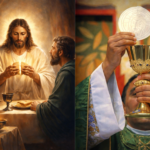
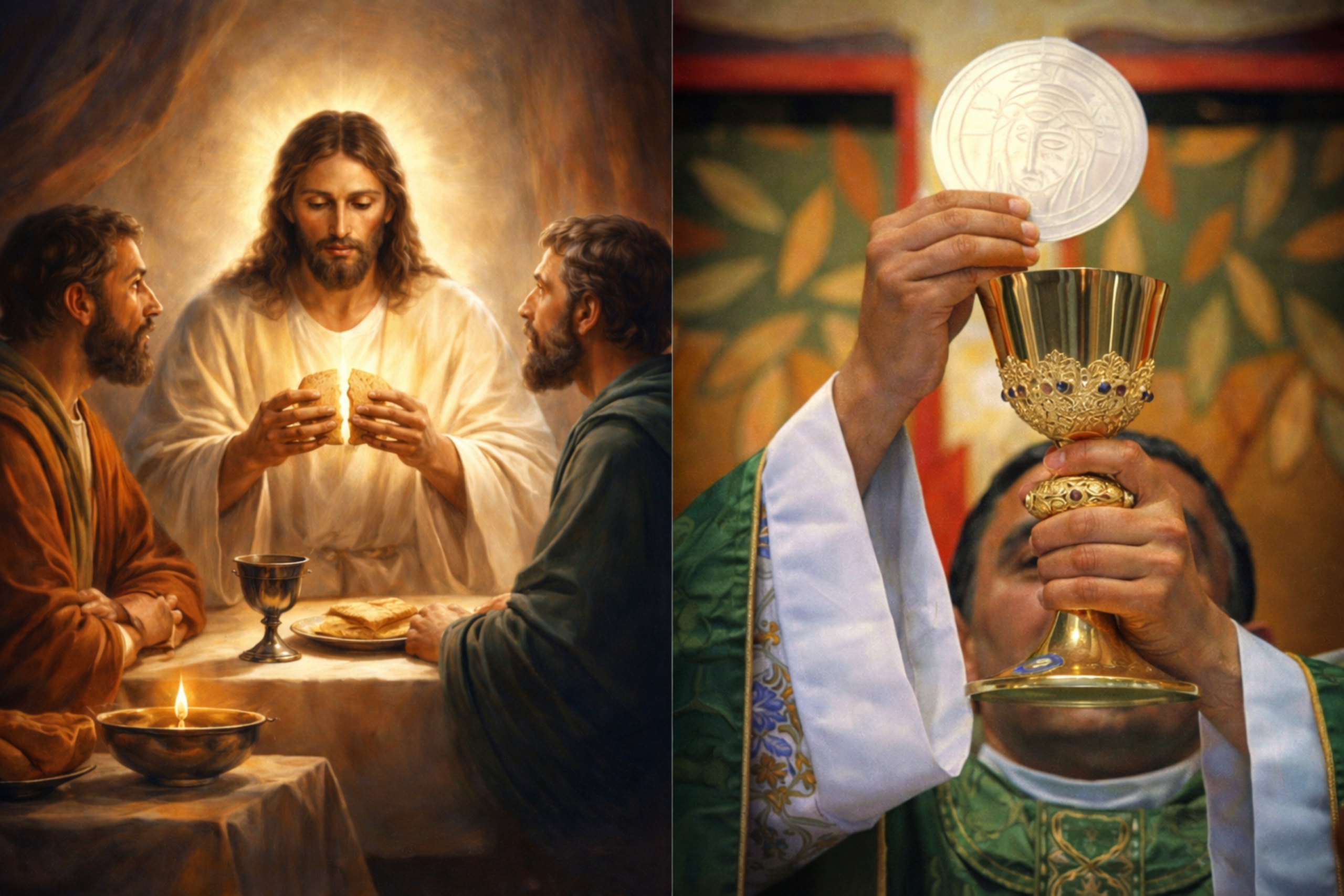
As evening falls, the two disciples urge him to stay. There is already a longing here, a deep, almost aching desire for communion, to remain in his presence, to be drawn beyond understanding into something more intimate, more real. Then, at the table, the decisive moment unfolds: bread is taken, blessed, broken, and given.
This is where recognition comes to fulfilment, not because the Eucharist is a helpful symbol for their feelings, but because in the Eucharist Christ’s Passover is made present. The Church proclaims and celebrates Christ’s mystery in her liturgy so that the faithful may live from it and bear witness to it in the world. And it is especially in the divine sacrifice of the Eucharist that the work of our redemption is accomplished.
When the Church celebrates the Eucharist, she commemorates Christ’s Passover in a way that is more than recollection. The memorial is not merely the recollection of past events but the proclamation of God’s saving works; in the liturgical celebration, these works become present and real. In the New Testament, that memorial takes on its fullest meaning: the sacrifice Christ offered once for all on the cross remains ever present, and the work of redemption is carried out whenever the Cross is celebrated on the altar.
For this reason, the Eucharist is not only a sacrament of encounter, but also the sacramental offering of Christ’s unique sacrifice. The Catechism (1362) teaches: the Eucharist is “the memorial of Christ’s Passover, the making present and the sacramental offering of his unique sacrifice.”
Here, then, the breaking of the bread is no mere sign that points elsewhere. It is the moment in which heaven touches earth, the moment in which Christ gives himself, wholly and without reserve.
Not merely remembered but present in the fullest sense
The disciples recognise him in the breaking of the bread. This is profoundly true, but it must be said with precision: Christ’s Eucharistic presence does not wait for recognition in order to be real. The Church teaches that the “mode of Christ’s presence under the Eucharistic species is unique” (CCC 1374). Christ is present “in the fullest sense… it is a substantial presence by which Christ, God and man, makes himself wholly and entirely present” (CCC 1374).
Thus, while Christ is present in other ways in the liturgy, including in the assembly gathered, in the presiding minister, and in the word proclaimed, the Church clearly affirms that the mode of Christ’s presence under the Eucharistic species is unique. The Eucharist is “presence par excellence”; “that is to say, it is a substantial presence by which Christ, God and man, makes himself wholly and entirely present” (CCC 1374).
This gift is grounded in the Church’s faith in transubstantiation. By the consecration, there is a change of the whole substance of the bread into the Body of Christ and the whole substance of the wine into the Blood of Christ; this change the holy Catholic Church has fittingly and properly called transubstantiation” (CCC 1376).
So when the disciples’ eyes were opened, they came to recognise not merely a momentary apparition. They recognise the risen Lord who is truly present and offered.
“He vanishes from their sight”—but presence remains
Then, as suddenly as they perceive him, he is no longer visible to them. This belongs to the Gospel’s narrative realism: sight is altered. Yet it must not be interpreted as if Christ’s gift depended upon their ability to see or feel. In the Eucharist, Christ is truly present under the species, not only as a remembered scene but as a living reality offered for communion.
The disciples do not treat the moment as a fleeting inspiration. They rise at once, their sorrow forgotten, their weariness overcome, and they hurry back to Jerusalem and proclaim what they have experienced. The night no longer frightens them. The distance no longer burdens them. Their hearts, once heavy, now overflow. Their mission flows from encounter, but their encounter rests on reality, not on imagination.
The pattern for every Christian life
So the Emmaus story becomes a pattern for the Church: We gather, often burdened, often distracted, carrying within us unspoken disappointments and quiet fears. The Word is proclaimed, and Christ draws near, burning our hearts through the Gospel. We come towards the table, and in the Eucharist, Christ’s Passover is made present; the unique sacrifice is sacramentally offered, and Christ gives himself wholly and entirely.
And if our hearts are truly opened, the response cannot be indifference. It cannot be stillness. The Eucharist does not leave us as it finds us.
The Mass does not end in quiet closure. It sends us forth as the Easter people whose minds, hearts, and steps have been redirected by Christ’s own action in the liturgy. It ignites a fire within us that seeks to spread the joy of Christ and refuses to remain hidden.
In a world that often walks away in quiet despair, the Eucharist remains the place where Christ’s presence is encountered with such fullness that hope is reawakened, not as a mood, but as communion with the living God.
God is not merely remembered, but He is truly encountered. And having received him, we ought to return not as those who only speak of what might have happened, but as those who proclaim what Christ has truly given.
Prayer
Lord Jesus, risen and living, walk with us on our roads when our eyes are slow, and our hearts are dull. Open the Scriptures to us so that our hearts may burn. Stay with us at your table, and in the breaking of the bread, make yourself known. Then send us back to the world as witnesses of your Passover, living from the mystery we celebrate, and bearing witness to your redemption. Amen.