




Collect Prayer of today: O God, who on this day revealed your Only Begotten Son to the nations by the guidance of a star, grant in your mercy that we, who know you already by faith, may be brought to behold the beauty of your sublime glory. Through our Lord Jesus Christ, your Son, who lives and reigns with you in the unity of the Holy Spirit, God, for ever and ever – Amen.
This prayer of the Church already interprets the mystery of the Epiphany it celebrates. It confesses that revelation is not seized by human effort but received as a gift; that faith, though real, remains a pilgrimage; and that glory is disclosed not in overpowering brilliance, but through guidance—through a light given for the journey. The Collect thus places us within the very movement of Epiphany: drawn onwards by grace, led from faith toward vision.
The narrative of the Magi unfolds beneath a paradox that is as luminous as it is unsettling. On the one hand, a star rises—silent, patient, obedient to a higher order—summoning seekers from distant lands. On the other, the shadow of Herod darkens the horizon, a shadow cast by fear, power, and the refusal to adore. Yet it is precisely within this tension that the Gospel reveals one of its most consoling truths: God’s light is not extinguished by human darkness; rather, it shines all the more clearly within it.
The path of the Magi necessarily passes through Jerusalem, through the court of Herod. This is no detour. Salvation history does not bypass the structures of power, nor does it pretend that evil can be ignored. Herod embodies the tragic distortion of kingship: authority severed from truth, power emptied of service. He knows the Scriptures, yet he does not move; he hears of the Messiah, yet he does not adore. In him, we see the drama of a heart closed in on itself. And still, God’s plan is not thwarted. The same prophecy that unsettles Herod becomes the map that leads the Magi to Bethlehem. Divine providence quietly overrules human malice, not by force, but by fidelity.
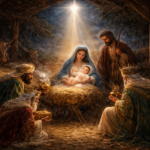
When the Magi arrive in Bethlehem, the star comes to rest. This detail is not incidental. It signals that the journey of the restlessness of the heart has found its ultimate rest. What the heart had sought through distance, study, and movement is now given in the Real Presence. They do not find an answer to a problem but a resting place for desire itself.
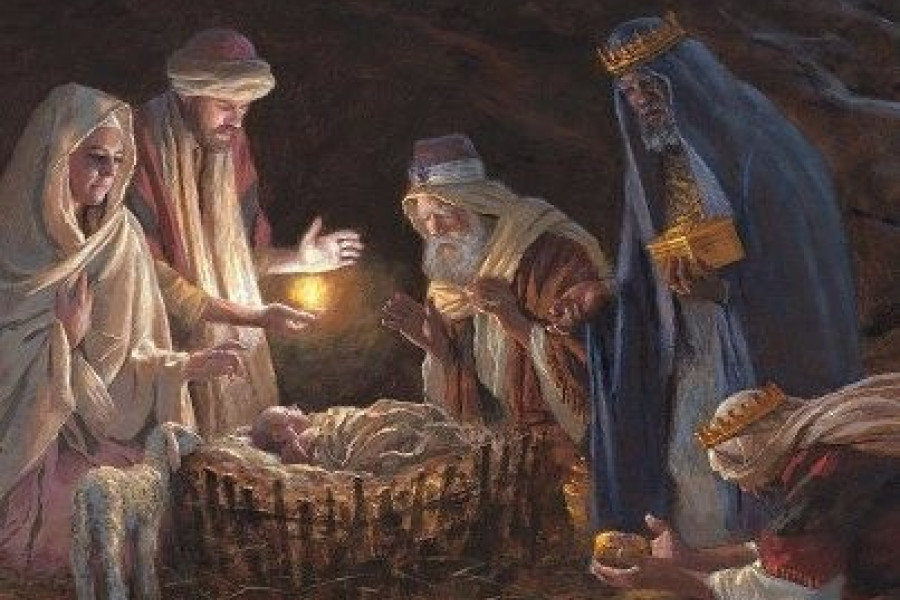
Before the Child, the long restlessness of their search is gathered into stillness. They fall to their knees, for the heart recognises, before the mind fully grasps, that it has come home. Gold, frankincense, and myrrh are offered as the language of adoration—signs that the heart is no longer turned inward upon itself but rather has found the One for whom it was made.
They find no throne, but a Child in a simple manger; not domination, but vulnerability; not spectacle, but presence. They fall to their knees, for true wisdom always ends in adoration. In this act, the nations of the earth are gathered before the Incarnate Word.
Here, the mystery opens toward the Eucharist. For the same Christ whom the Magi adored under the form of a child now gives himself under the humble signs of bread and wine. The logic is identical: God makes himself small so that we may draw near; he conceals his glory so that faith may be free. As the Magi allowed themselves to be led by the star, so the Church allows herself to be drawn by the Eucharistic presence of the Lord—often in a world still overshadowed by new Herods and new forms of fear and control.
The Eucharist is thus the star of our pilgrimage. It does not dazzle, nor does it coerce; it guides the heart and soul for a greater experience. In every Mass, Christ allows himself to be found, not by the powerful, but by those willing to hungry for His presence. And like the Magi, those who truly encounter him cannot return by the same way they came. To enter into communion with Christ is to have the path of human life inwardly transformed. Having adored and received, we are sent transformed.
Thus, Epiphany reaches its fulfilment at the altar. The star still shines, the heart still seeks, and Christ still offers himself as the place of rest. The question remains, as urgent as ever: will we allow our restlessness to lead us to adoration, and our adoration to find its repose in him who alone can say to the human heart, “Come to me, and I will give you rest”?