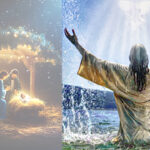







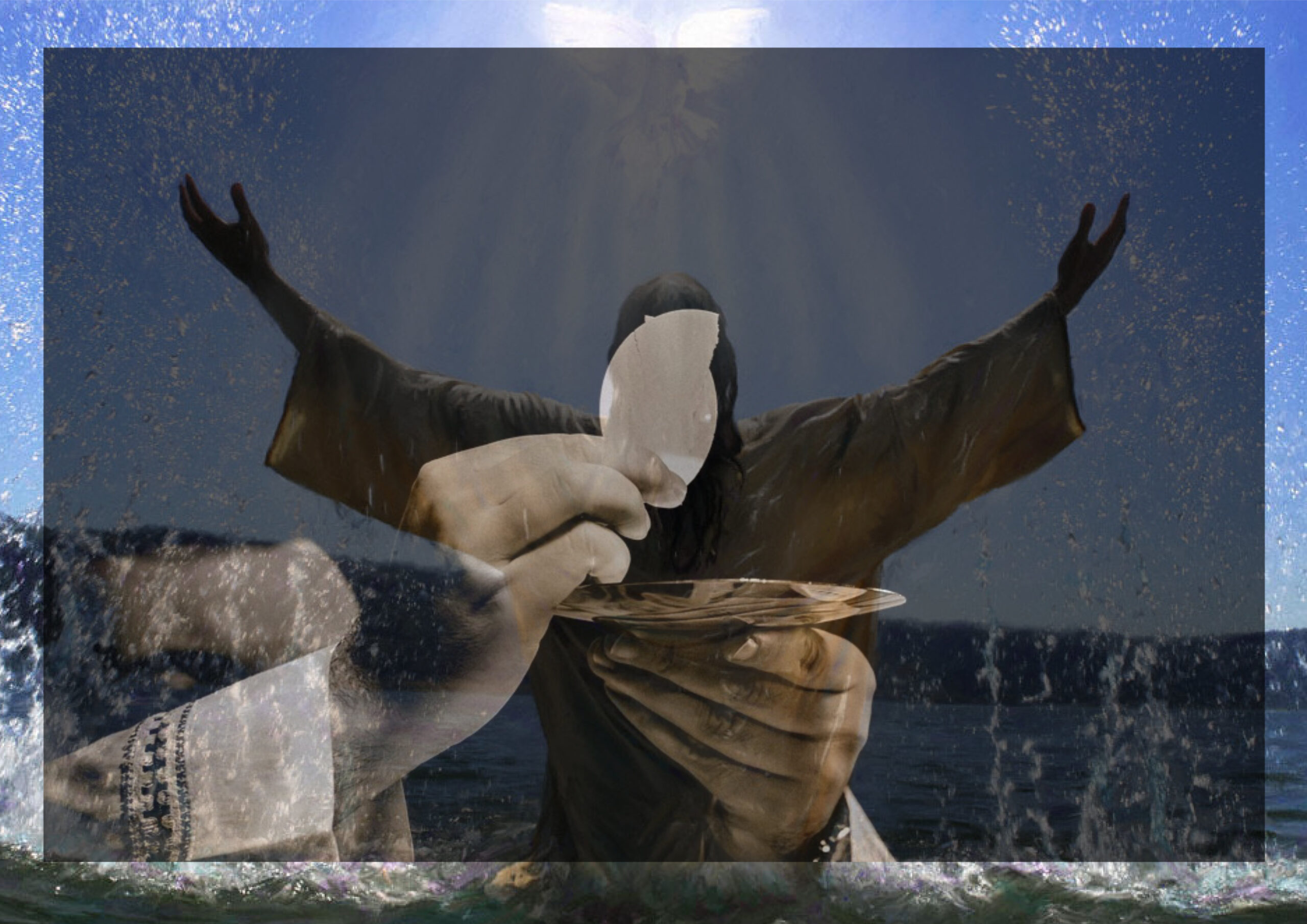
John’s word is simple, almost austere, yet it opens an abyss of meaning: “Behold, the Lamb of God.” It is not a cry of excitement but of recognition — the quiet astonishment of one who has been permitted to see. In this moment, by the waters of the Jordan, the history of sacrifice, longing, and promise reaches its hidden fulfilment. The lambs of Israel, whose blood once spoke of deliverance, fall silent before the Lamb who bears within himself the obedience of the Son and the mercy of the Father.
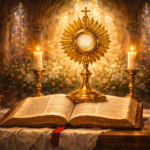
This gaze of John is the gaze the Church must learn again and again at the altar. Before any word is spoken, before any action is taken, the liturgy asks us to behold. The Eucharist begins not with grasping, but with receiving — with allowing the mystery to stand before us in its unprotected truth. The Lamb who takes away the sin of the world does not do so by force, but by offering himself, and this offering becomes present, quietly and unassumingly, under the signs of bread and wine.
John confesses that he did not know him, until the Spirit descended and remained. Knowledge here is not information but communion. The Spirit reveals the Son not to the clever, but to the one who waits. This same Spirit, who once rested upon Christ in the humility of the Jordan, is invoked upon the Church’s gifts, so that what lies on the altar may become the body given and the blood poured out. The Jordan and the altar thus mirror one another — both are places where heaven opens and the Spirit rests. What occurred once in history is now made present sacramentally, not as repetition, but as abiding presence.
To say “This is the Son of God” is therefore not a conclusion but a surrender. In the Eucharist, the Church dares to believe that the Son continues to come, continues to give himself, continues to remove sin by drawing humanity into his own self-offering to the Father. Each Communion is a silent echo of John’s testimony, spoken not with the voice, but with the body: I have seen, and I have received.
Thus, the Baptist still stands at the threshold of every Eucharist. He does not draw attention to himself; he points away, into the mystery. And the Church, standing beside him, learns that faith is nothing other than this: to behold the Lamb, and to allow oneself to be consumed into his gift.