




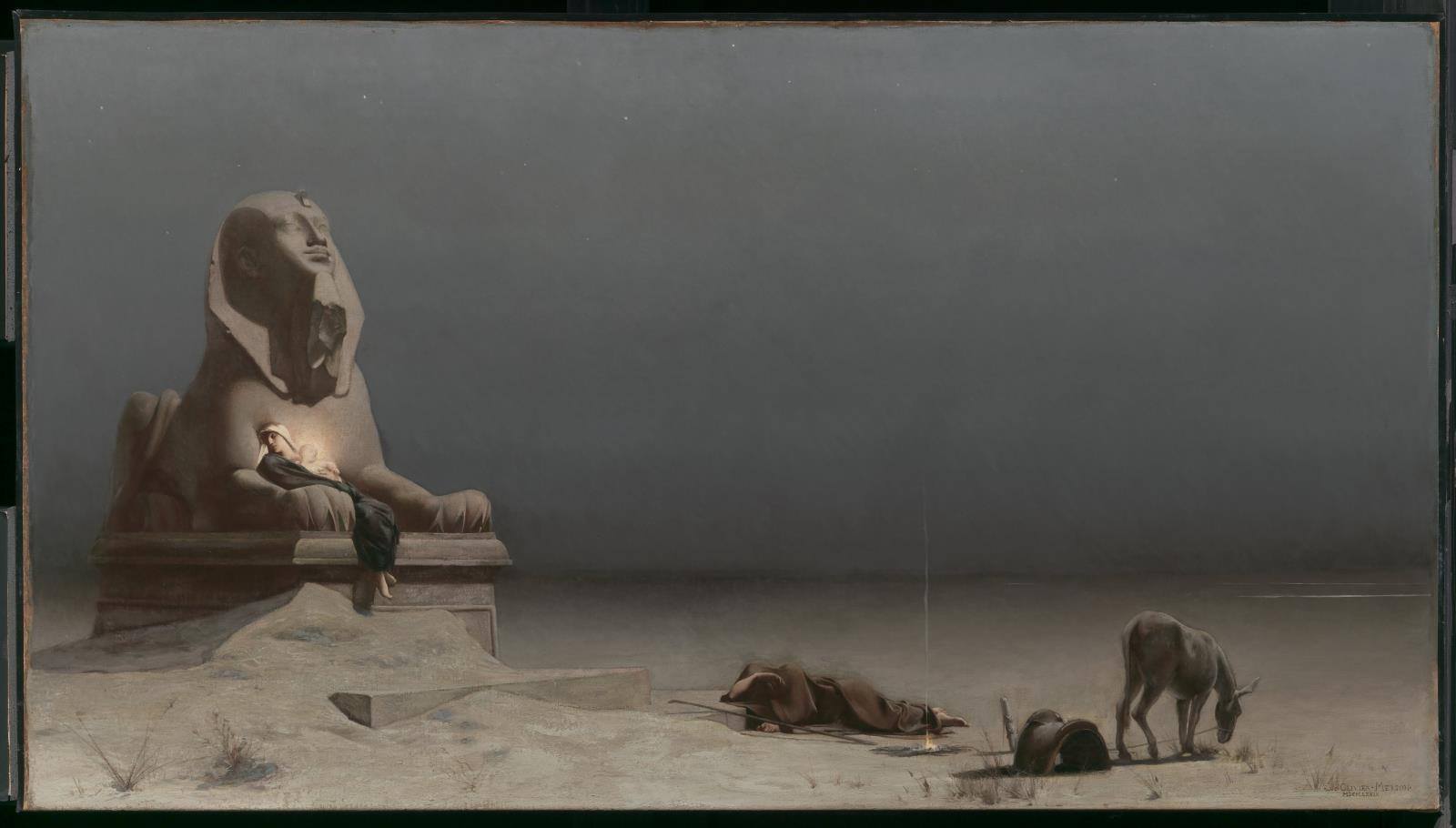
Here, in Luc-Olivier Merson’s Rest on the Flight into Egypt (1879), the Gospel is rendered not with movement but with silence, just before the silence was shattered by the screams of the holy innocent ones who were slaughtered on Herod’s orders.
The drama of Matthew’s brief sentence—“Joseph rose and took the child and his mother by night and departed to Egypt” (Mt 2:14)—is translated into a vast silence. The Holy Family has fled, yet the painting lingers not on escape but on exile, not on danger alone but on the strange peace that follows obedience.
The scene is austere. The colossal Sphinx looms above Mary and the Child, a monument of stone wisdom and mute power, ancient and inscrutable. At its base, almost swallowed by the immensity of empire and history, Mother Mary rests with the infant Jesus pressed close to her breast. Joseph lies asleep on the ground, exhausted. The donkey grazes nearby, indifferent to the cosmic weight of the moment. Everything appears still—yet everything has changed.
The Silence of Obedience
Silence is never emptiness; it is space for listening. Joseph’s silence in the Gospel is total, he speaks no recorded word, yet his obedience resounds through salvation history. He rises “by night”, without argument, without delay. In the painting, his body bears the cost of this obedience: he is collapsed, spent, utterly human. This is not the heroism of spectacle but the heroism of fidelity.
Herod’s violence is not shown, yet it presses upon the scene like the dark horizon behind them. Tyranny does not always announce itself with noise; often it operates through fear, displacement, and the slow erosion of safety. The Holy Family do not confront power; they withdraw from it. And in this withdrawal, God’s redemptive strategy unfolds, not through domination, but through humility.
God Among the Ruins of Empire
The Sphinx is no decorative element. It is theology in stone. Egypt represents the ancient wisdom of the world, the memory of Israel’s former bondage, and the enduring illusion that salvation can be engineered by power, mystery, or monument. Yet here, at the foot of this colossal symbol, God rests as an infant.
This is the paradox at the heart of the Incarnation: the Word does not argue with the world’s greatness; He simply lies beneath it. The Sphinx remains, but it does not save. It watches, but it does not love, because it has no life and emotion. Beneath it, Mary shelters the One through whom all things were made. History’s weight presses down, yet grace abides quietly within it.
Christianity does not abolish culture but purifies it from within. The Child does not shatter the Sphinx; He sanctifies the ground beneath it by His presence. God enters exile, not as a conqueror, but as a guest.
The Vulnerability of God
What arrests the viewer is not fear but tenderness. Mary does not clutch the Child in panic; she holds Him with calm attentiveness. The light that falls upon them is soft, almost Eucharistic, as though the world itself pauses to adore.
Here we confront a truth that unsettles modern sensibilities: God chose vulnerability. The omnipotent Word becomes dependent on a mother’s arms, a father’s obedience, an animal’s strength, and a foreign land’s mercy. Salvation enters history not shielded from threat, but exposed to it.
In life, stability is a vow—not because the world is safe, but because God is faithful. The Holy Family’s flight is a wound to stability, yet it is precisely here that we learn what true stability means: not the absence of danger, but steadfast trust in God amid displacement.
The Night That Protects the Light
The vast darkness of the painting is not hostile; it is protective. God often chooses night as the cloak for His work. Israel leaves Egypt by night. The Resurrection dawns before sunrise. And here, the Light of the World rests while the world sleeps.
Herod represents a power terrified of losing control. The Child represents a Kingdom that grows precisely by not defending itself. One kills infants to preserve a throne; the other survives by being carried, hidden, entrusted.
This is not weakness—it is divine patience.
A Mirror for the Church Today
The Church, too, knows exile: marginalisation, misunderstanding, persecution, and the quiet fatigue of fidelity in a restless world. Merson’s painting invites us to ask not how loudly we resist, but how faithfully we remain.
Are we willing to be small beneath the monuments of modern certainty? Are we willing to trust that God works even when His presence seems hidden, displaced, or fragile?
The Holy Family does not know how long Egypt will be home. They know only that God has spoken—and that is enough.
Resting in God’s Fidelity
This painting is not merely about flight; it is about rest. The Child sleeps. Joseph sleeps. Though Mary appears to be sleeping, yet she is alert and protective of her Child. The world remains vast and threatening, yet God is already at work.
Ancient wisdom tells us that to rest is not to abandon vigilance but to place one’s trust wholly in God. The Holy Family rests not because danger has passed, but because obedience has been fulfilled.
And so the Church is invited, again and again, to kneel beside them in the silence—to learn that salvation advances not by force, but by faith; not by monuments, but by mercy; not by fear, but by love made small.
At the foot of the Sphinx, beneath the weight of history, God rests—and the world is being saved.