





In the sacred drama of salvation history, few moments in the Old Testament speak with such solemn intensity, such as the sealing of the covenant in Exodus. Moses takes the blood, sprinkles it upon the people, and declares: “This is the blood of the covenant which the Lord has made with you according to all these words” (Ex 24:8). At first sight, this gesture appears distant, even unsettling to modern sensibilities. Yet within it lies a profound theological intuition: life is bound to life through blood, and communion with God demands a covenant sealed not in mere words, but in sacrifice.
The blood of animals, offered upon the altar, signified both atonement and belonging. It marked Israel as a people set apart, bound to the Lord not by abstraction but by a visible, tangible sign. Yet this covenant, real and sacred as it was, remained prefigurative, just like the manna from heaven (Ex 16:4). It pointed beyond itself, as every sacrifice of the Old Law does, towards a fulfilment not yet revealed.
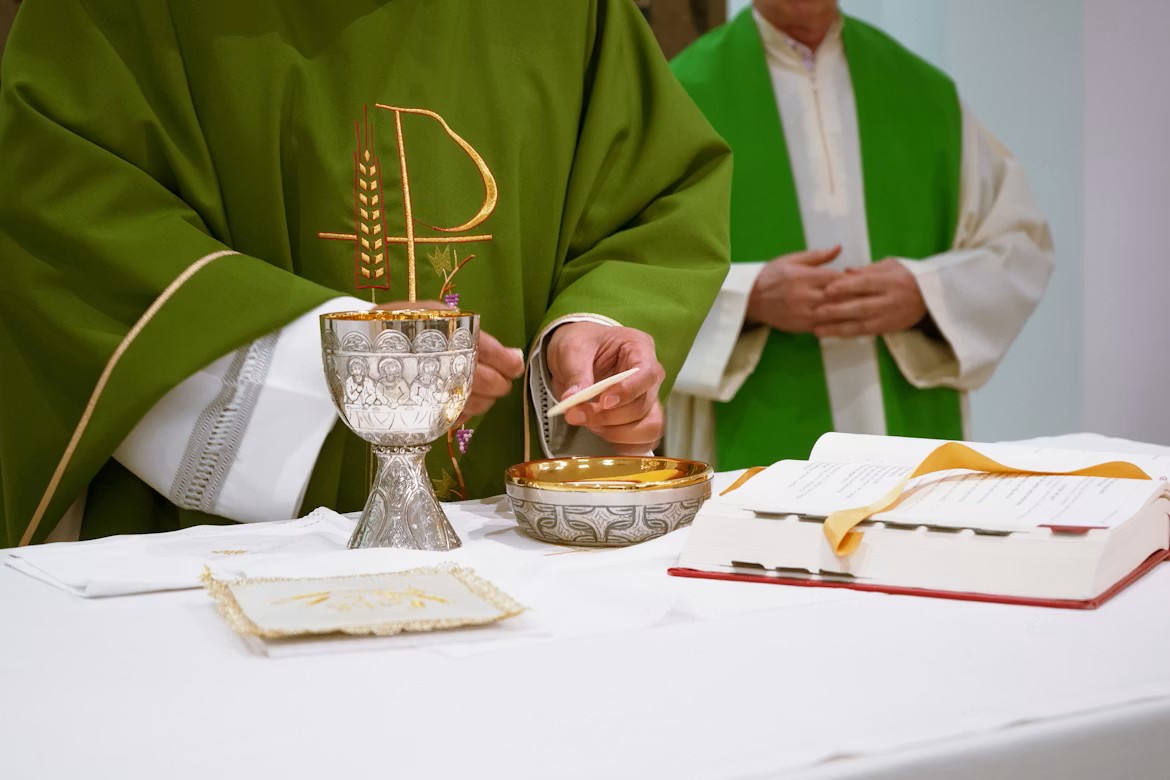
But in the fullness of time, the covenant is no longer ratified by the blood of irrational creatures, but by the very life of the Son of God. In Jesus Christ, sacrifice is not something merely external. God offers himself. The Eucharist thus remains the sacrificial memorial of Christ and his Body, Blood, Soul and Divinity, and the sign is truly effective, because Christ is present in the fullest sense, truly, really, and substantially under the species of bread and wine. On the night before he suffered, Christ gathered his disciples and spoke words that reconfigure all prior sacrifice: “This is my Body, which will be given up for you… This is the chalice of my Blood, the Blood of the new and eternal covenant”. Words that are repeated at every Mass.
Here the language of Exodus is not abolished but transfigured. What Moses once did by sprinkling blood upon the people, Christ now accomplishes by giving His Body and Blood to be consumed. The movement is striking. It is no longer a question of blood being sprinkled upon the people, as a sign of covenantal belonging.
In this mystery, God truly feeds us with His own Body and Blood as real food, nourishing and augmenting our lives most intimately. What may first sound startling becomes, in the light of faith, the heart of divine love: our sacred sustenance, which augments our lives, comes from God.
Here, there is a divine mandate that surpasses all prior forms of covenantal communion. God no longer externally marks His people. He enters into them through the Eucharist. He gives not only His grace, but His very Body and Blood. This is not symbolic consumption, but real participation. Christ is not received as an object among others, but as the living God who communicates His own life to us.
In John 13:23-25, the disciple (John) whom Jesus loved leans on Jesus; however, at the Supper of the Lamb, this action is inverted: when we receive God in the flesh during Holy Communion, He leans on us from within to comfort us and to express His love in the most intimate way.
However, God does not need to enter us for His own fulfilment. In His gratuitous love, He wills to be united with us in a way that heals what is wounded, restores what is broken, and elevates what is merely natural into participation in the divine life.
When we consume the Body and Blood of Christ, it is not an act of human possession but an act of divine indwelling: we receive in order to be transformed and become what we receive to share with the world around us, such that, by this commingling, we participate in Christ’s own life and are elevated in our nature to the divine life.
Thus, the covenant once sealed on Sinai reaches its definitive expression not in external sprinkling, but in interior communion. The Eucharist is therefore not simply a holy thing among other holy things. It is the epicentre of the new covenant, in which God gives not merely signs of His love, but presents to us His very self. And in this gift, the deepest desire of God is made manifest: to dwell with us, not from afar, but within, until all is healed and made new in Him. If the beloved disciple once rested upon the breast of Christ at the Last Supper, the Eucharist reveals an even deeper intimacy, for Christ Himself comes to dwell within the faithful, drawing us into interior communion with His divine life until we behold Him face to face.