






Palm Sunday stands at the threshold of the great drama of Holy Week. In the Gospel of Matthew (21:1–11), a striking and often overlooked detail emerges: Jesus Christ enters Jerusalem with two donkeys, a deliberate fulfilment of Book of Zechariah 9:9.
Origen of Alexandria offers a rich interpretative lens: the ass, tied and burdened, signifies the Old Testament, bound yet now loosened by the disciples, while the colt, young and unbroken, points to the New Testament, fresh and more readily received.
Thus, the evangelist presents not merely a historical episode but a profound theological sign: Christ the King who unites the old and the new, bringing Israel’s promises to fulfilment. Yet He comes not in splendour, but in humility—revealing a kingship the world does not expect.
Christ does not ride a war horse, but a donkey. Not a symbol of conquest, but of humility. Not the triumph of domination, but the quiet authority of obedience. In this, the Gospel unveils a truth that unsettles every worldly instinct: true kingship is not about power seized, but power surrendered.
The Misunderstood King
The crowd’s acclamation is sincere, yet incomplete. They cry out for deliverance, but imagine it in political or earthly terms. They long for a king who will overthrow, restore, and reign in visible glory. Yet Christ comes to overthrow something far deeper than imperial rule; He comes to conquer sin, death, and the tyranny of the human heart estranged from God.
Thus begins the great irony of Palm Sunday: the same voices that cry “Hosanna” will soon echo with “Crucify Him.” Why? Because the kingship of Christ refuses to conform to human expectations. It is not a kingship that flatters our desires, but one that calls us to conversion.
The Throne of the Servant
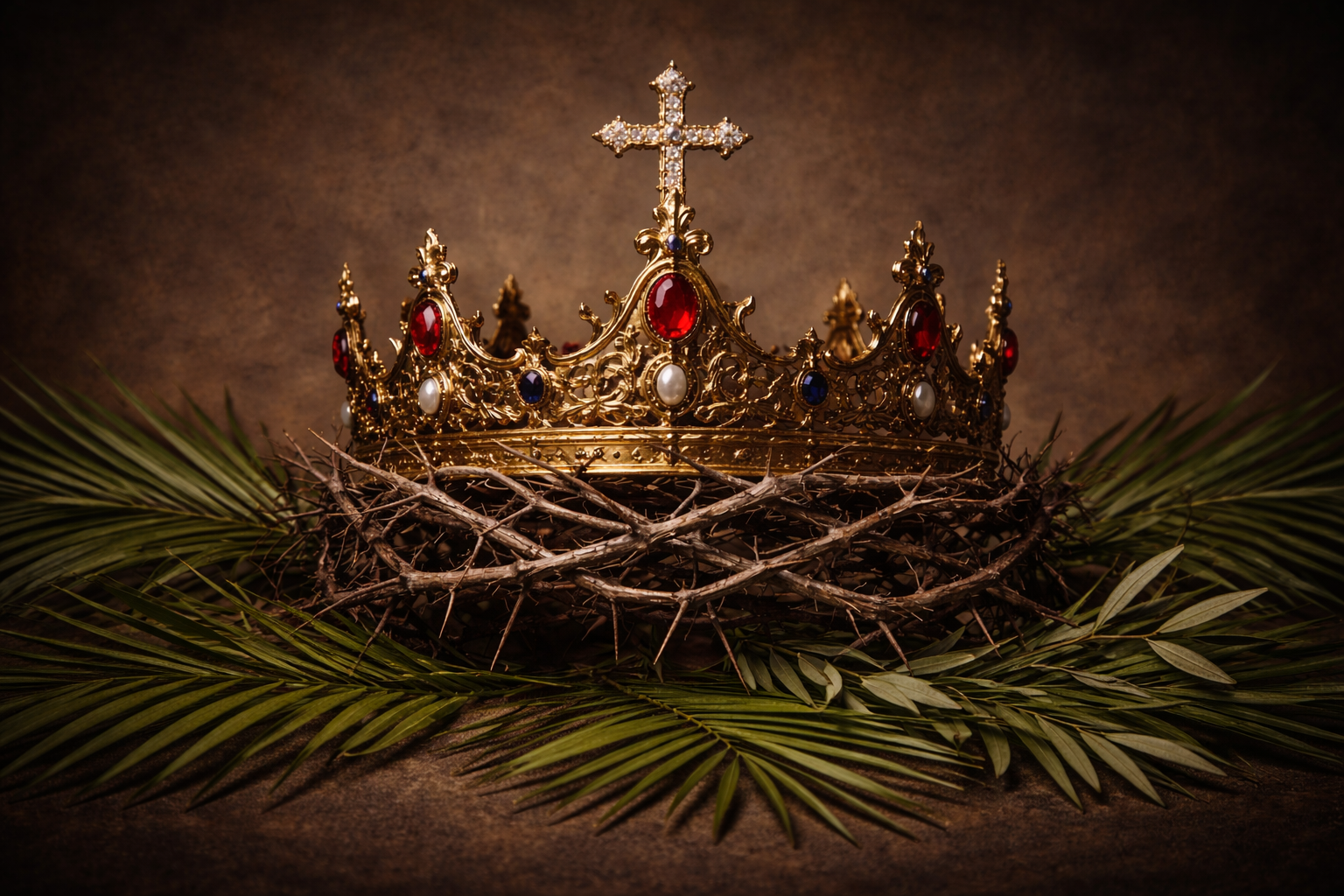
In Christ, kingship and servanthood are not opposites; they are united. His throne will not be a seat of gold, but the wood of the Cross. His crown will not be adorned with jewels but with thorns. His royal procession does not end in a palace, but in Golgotha.
Here lies the heart of Servant Kingship: authority expressed through self-gift. Christ reigns not by imposing His will, but by offering Himself. He does not grasp at power, but empties Himself in love. This is the logic of divine sovereignty—a sovereignty that kneels to wash feet, that stretches out arms to embrace the sinner, that chooses the Cross as the definitive act of reign.
A Mirror for Discipleship
Palm Sunday is not merely a remembrance; it is an invitation. If Christ is King, then His way must become ours. The disciple is called to embody this same paradox: to lead by serving, to gain by losing, to live by dying to self.
In a world that prizes visibility, influence, and control, the Christian is summoned to a hidden greatness the greatness of fidelity, humility, and sacrificial love. The palm branch we carry is not merely a sign of victory; it is also a quiet pledge: that we will follow this King, even when His path leads to the Cross.
From Hosanna to Fidelity
The question Palm Sunday poses is both simple and searching: What kind of King do we truly desire? One who confirms our expectations, or one who transforms our hearts?
To acclaim Christ as King is easy in the moment of procession. But to remain with Him in the hour of suffering—that is the test of true discipleship. The liturgy invites us to move beyond fleeting enthusiasm into enduring fidelity.
For the Servant King does not seek admirers; He seeks followers. Not crowds that cheer, but hearts that surrender.
Conclusion
As we enter Holy Week, Palm Sunday calls us to contemplate the mystery of a King who reigns by serving and saves by surrendering. In Him, power is redefined, glory is transfigured, and love is revealed in its most radical form.
Let us not merely wave palms from a distance, but walk with Him—into Jerusalem, into suffering, and ultimately, into the victory of the Resurrection.
Hosanna in the highest—blessed is He who comes, not to be served, but to serve, and to give His life as a ransom for many.